Direct from the Maker: What Importing Rugs from India Actually Involves
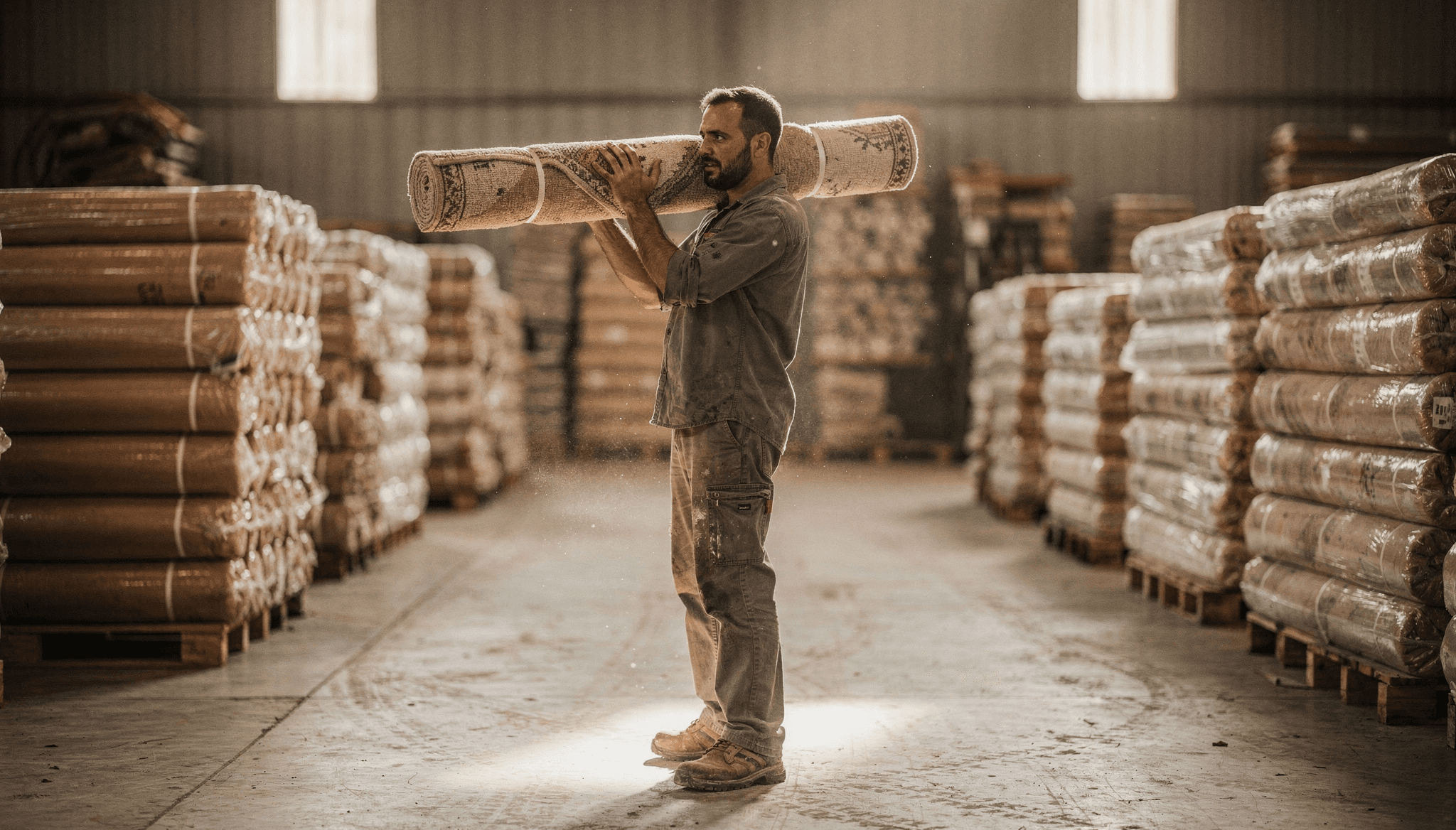
Between a loom in India and a showroom in Europe traditionally sit three to four trade layers. Each performs a function, each takes a margin, and by the end the works price of a rug has often multiplied without a single knot being added to the piece. Direct import means that chain falls away. What that concretely means, what it delivers and what it asks of you is the subject of this guide.
The classic trade chain and what it costs
The traditional path of an Indian rug to Europe runs through an exporter in the country of origin, an importer or wholesaler in Europe, and the retail floor. Each layer prices in its margin; across the chain the price at least doubles, often more. A second, less visible effect comes with it: every layer adds distance between you and the making. Special requests, color variants and size changes are passed through every hand between you and the loom, and every handover costs time and precision.
What the direct route changes
Three things: terms, control and provenance.
Terms, because you buy at manufactory price and the intermediary margins stay in your own calculation. For interior designers, studios and retailers, that is the difference between an adequate margin and a good one at a marketable end price.
Control, because your specification reaches the loom without translation loss. Dimension, color to a RAL or Pantone reference, pile height, pattern placement: you speak with the people making the piece, not their resellers. How that coordination runs in a project is covered in the contract and project guide.
Provenance, because a piece that comes straight from the manufactory has a documentable history: which wool, which dye, which workshop. In a market that rightly asks about supply-chain transparency, that is a selling point, not a footnote.
Incoterms: who carries what
Incoterms define the point at which cost and risk pass from seller to buyer. Three clauses matter for rug import.
EXW (ex works): you organize transport, insurance and clearance from the manufactory gate yourself. Sensible for importers with their own logistics.
FOB (free on board, e.g. FOB Mundra): the goods are handed over shipped; sea or air freight and import sit with you. The usual middle path for retailers with a freight forwarder.
DAP (delivered at place): Carpetstory delivers to your door; you handle nothing but acceptance. For designers and project clients without an import routine, the simplest form, on request including settlement of import charges.
Duty and tax in Europe
Handknotted wool rugs are classified under customs heading 5701.10. On import into the EU, customs duty applies along with import VAT at the rate of the destination country, in Germany 19 percent. For VAT-registered businesses, import VAT is a pass-through item: paid and reclaimed as input tax, so it does not burden the result. The applicable duty rate is itemized in the quote, so your calculation is complete before ordering, with no surprises at arrival.
It sounds like administration; it is routine. Under DAP, Carpetstory handles the process entirely; under FOB, any freight forwarder does it as standard business.
Transport and time
Shipping runs through the west-coast ports of Mundra or Nhava Sheva to Hamburg, Bremerhaven or the major North Sea ports. Plan for four to five weeks port to port, plus pre- and on-carriage. Samples, single pieces and deadline-critical deliveries travel by air in five to seven days, at a corresponding premium.
Rugs travel rolled, wrapped in tear-resistant film and fabric; sea freight in containers, cleanly separated from other goods in consolidated loads. Transport insurance is included or itemized in every quote.
Who this pays off for
Interior designers and decorators sourcing single pieces or project series to their own specification. Boutiques and retailers building a collection with documentable provenance and a healthy margin. And contract clients fitting out hospitality or office space who simply do not need the detour through middlemen.
What it asks of you is, at its core, one thing: lead time. Direct import is not a stock sale; the timeline of a production run plus freight applies. Plan for it, and you get the better piece at the better price, with a history that can be shown.
Send us your inquiry with quantity, dimensions and time horizon; you will receive a quote with a complete cost breakdown to the door within two working days.