Rugs for Contract and Project: A Working Guide for Architects and Interior Designers
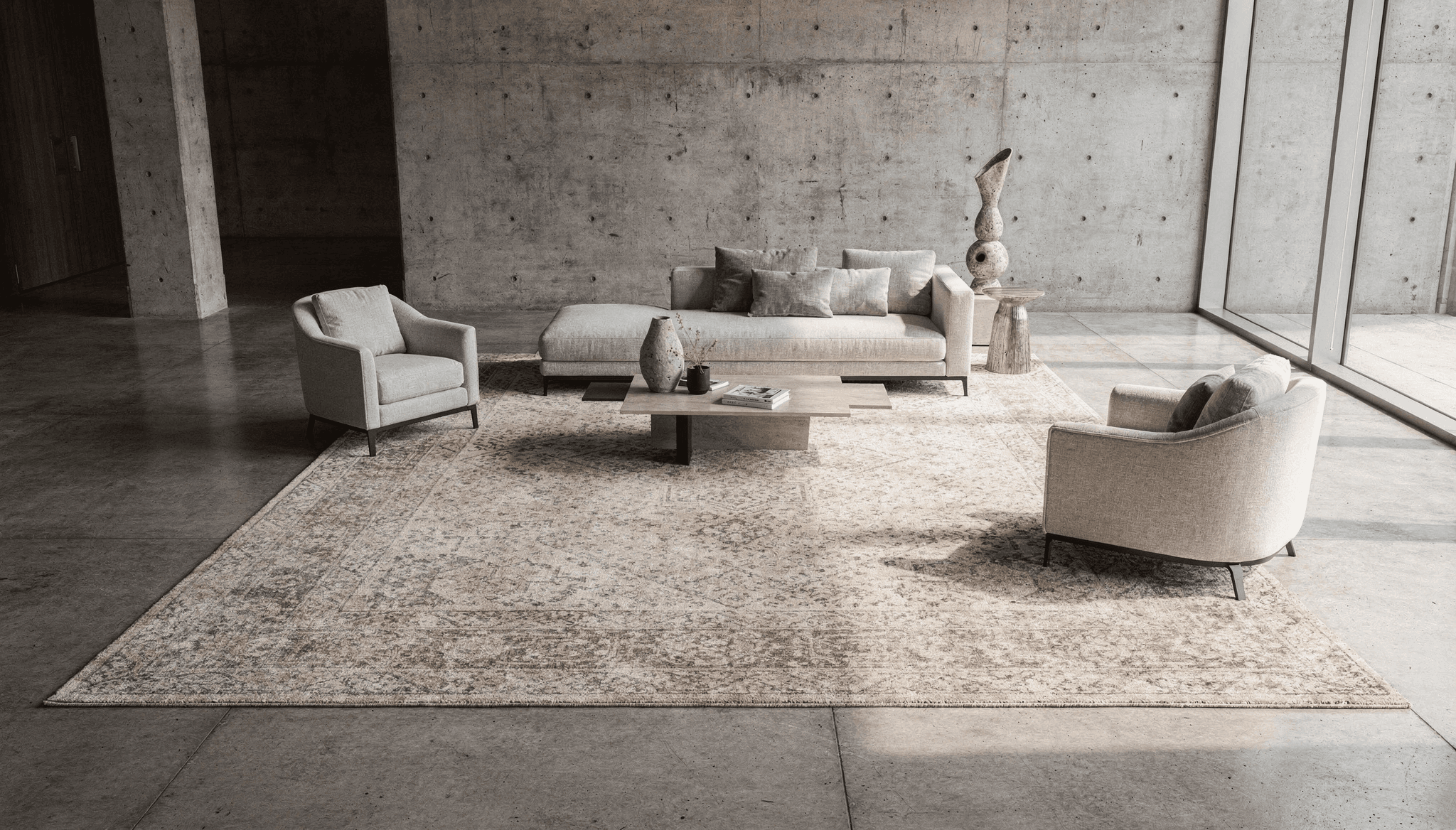
A handknotted rug in a project is not an accessory. It is a building component with requirements for dimensions, material, fire behavior and delivery date, and it should be planned like one. This guide covers what you need for the specification: material selection, color matching, sampling, a realistic timeline and the logic behind the price.
What contract quality means in a handknotted rug
Quality in a handknotted piece comes down to three measures: knot density, pile height and material. For contract use, what matters is how they work together.
Knot density describes how many knots sit in a square meter. Robust contract qualities start at around 100,000 knots per square meter; fine qualities reach 250,000 and beyond. Higher density sharpens the pattern, and it also stabilizes the surface: the more knots, the less room the pile has to shift under load. The piece on understanding knot density goes deeper.
Pile height determines feel and maintenance. In trafficked areas, a short to medium pile of six to eight millimeters has proven itself: it shows fewer walk paths, cleans more easily and keeps the pattern crisp over years.
On material, contract work runs on wool. More on that next.
Material: wool carries, silk accents
Wool is the working material of the handknotted rug, for good reasons. The fiber is elastic and recovers after compression. Its natural lanolin content repels dirt. And wool is inherently flame resistant: it ignites only at very high temperatures and self-extinguishes, which is regularly the deciding factor in contract settings. Carpetstory works with long-staple highland wool, blended where the quality calls for it with New Zealand wool for a brighter, more even dye uptake.
Silk and bamboo silk bring luster and depth but less abrasion resistance. In a project they belong where footfall is low: accent fields, pattern details, suites rather than corridors. A wool and silk blend combines both characters and is often the smartest choice for representative spaces. The differences are covered in detail in wool, silk and bamboo silk.
Project-specific requirements for fire rating or slip resistance are best raised before specification; much can be solved through material, underlay and finishing.
Size, shape and tolerance
Handknotting has no standard formats. Each piece is made individually on the loom, so it is made to the room: a runner for a gallery, an eight-meter field for a lobby, round, oval, or cut around columns and fireplaces, worked from the floor plan.
Honesty belongs in the planning: a hand-made piece carries a dimensional tolerance of about two percent, in practice usually less. On a four-meter rug that is a few centimeters. Where the fit must be flush, in a recessed floor for instance, design the tolerance in or raise it early. Possibilities, limits and process are covered under made-to-measure rugs.
Color: from reference to wool
Color matching to RAL, Pantone or NCS is standard in project work, and on hand-dyed wool it works differently than on industrial goods. The path runs through the material itself: you name the reference, the dye house produces dyed wool samples, you approve on the physical sample. Only then does production begin.
Two characteristics are worth knowing. Wool refracts light differently from paint or paper; the same recipe reads warmer and deeper on fiber than on the swatch card. And hand dyeing carries a fine, living variation across the field, the so-called abrash, which in vegetable-dyed qualities is part of the aesthetic. Where a technically exact, fully homogeneous color field is required, chrome-dyed wool serves better than plant dye. The full workflow is described in color matching to RAL and Pantone.
Sampling
No project without a sample. Standard practice is a hand sample of roughly 30 by 30 to 60 by 60 centimeters in the specified quality, color and pile height. Producing a hand sample takes two to four weeks; shipping is by air. For color decisions earlier in the process we assemble wool poms, small dyed yarn samples that sit directly against the project's fabrics, timbers and surfaces.
The sample is the reference for the entire production. What is approved on the sample holds for the finished piece.
Timeline
Handknotting takes time, and serious planning budgets for it. The spans below apply to a single custom piece; multiple pieces in a series are largely produced in parallel.
| Step | Duration | |---|---| | Design, technical drawing, approval | 1 to 2 weeks | | Dyeing the wool | 2 to 3 weeks | | Knotting (depends on size and density) | 8 to 16 weeks | | Washing, shearing, finishing | 2 to 3 weeks | | Sea freight to Europe | 4 to 5 weeks |
In total, 16 to 24 weeks from approval is realistic. Air freight shortens transport to about a week, at a premium. Where the move-in date is fixed, plan backwards from the date and start sampling early; it is the only step that can be pulled forward without costing quality.
Pricing logic
The price of a handknotted rug follows a simple mechanic: area times knot density times material, plus the complexity of shape and pattern. A weaver ties a limited number of knots per day at a given fineness; doubling the density essentially doubles the labor in the piece. Silk content raises material value; special shapes raise construction effort.
For budgeting, that means knot density moves the price more effectively than size does. A generous format in solid contract quality is often more economical than a small piece at museum fineness, and almost always the stronger decision in the room. Because Carpetstory ships directly as the maker, the trade layers between loom and project fall away; what that means for terms and logistics is covered in direct import.
Working with Carpetstory
You work directly with the manufactory: one contact from first sketch to delivery, access to dye house and loom, production status with photo documentation on request. We produce from a single piece, in any size, to your color reference, and deliver duty-paid to the door if you wish.
For a first assessment, a floor plan, target size and a color direction are enough. Send us your project inquiry; you will receive an assessment of feasibility, timeline and budget range within two working days.