Bhadohi: India's Carpet Heartland
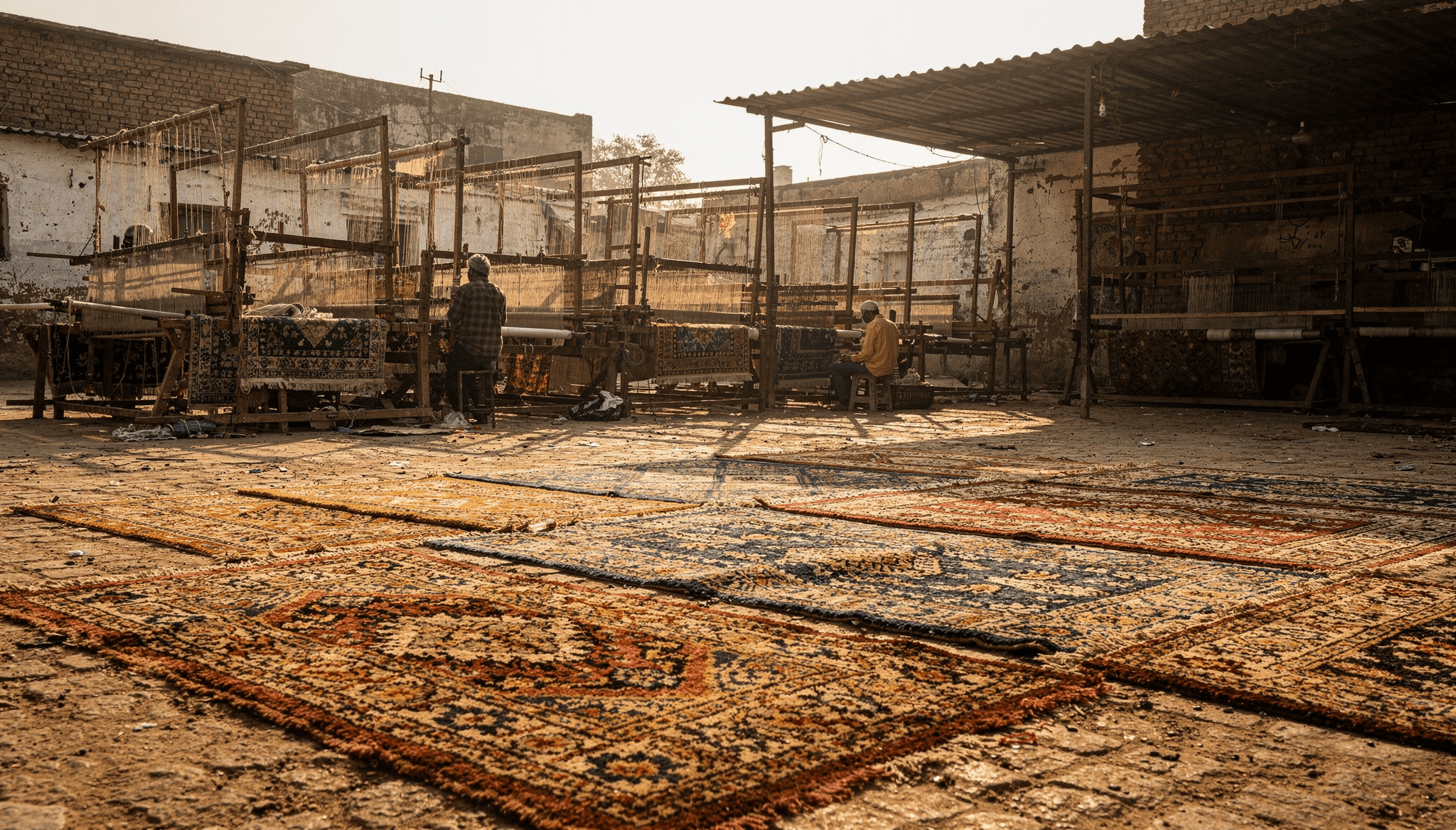
There are places where a craft is at home, and there are places that consist of a craft. Bhadohi, a district on the Gangetic plain between Varanasi and Prayagraj, belongs to the second kind. Drive through it and you see warp threads stretched between posts, freshly dyed wool over poles in the sun, washed rugs laid out to dry in courtyards, and from open doors you hear the even beat of the combs with which weavers strike down row after row. Together with the neighboring district of Mirzapur, Bhadohi forms the largest contiguous knotting landscape in the world. If India is the country of the handknotted rug, this is its heart muscle.
A caravan, a beginning
How knotting came to the Ganges is told by tradition as a travel story: Persian weavers, moving with a caravan in the Mughal era, are said to have halted in the villages of the region and left their craft behind. How much legend is in it can no longer be untangled; what is certain is that the region has knotted for centuries, and that out of the courtly roots of the Mughal age, which the essay on India's knotting art traces, a craft of the villages grew here. The nineteenth century brought the export trade to the region, the twentieth grew it into the center of the Indian rug business, and since 2010 the handmade carpet of Bhadohi has carried a registered geographical indication, of the kind otherwise reserved for wine appellations and cheeses.
An ecosystem, not a location
What makes Bhadohi singular is not any one manufactory but the completeness. The entire chain of the craft lives here side by side: wool traders and spinners, dye houses with their kettles and drying yards, draughtsmen who translate designs into knot plans, tens of thousands of looms in workshops and homes, and the washers, shearing masters and finishers who turn the raw rug into the finished piece. Several hundred thousand people live directly from knotting; counted with their families, the number runs into the millions.
This density is more than statistics. It means that skill here is measured in generations and knowledge is available within walking distance: a dye master setting a difficult nuance, a shearing master giving a relief its depth, a draughtsman translating a European design into the language of knots, all part of the same fabric. In practical terms it also means that nowhere can patterns be sampled faster, qualities compared more broadly, or special requests connected more directly than where the whole craft is assembled.
What the belt lives on
Bhadohi knots the entire spectrum, from the simple export piece to the fine individual commission, and precisely this range has shaped the region's reputation, for better and worse. Its true strength lies in the robust woolen knotted rug: pieces with body and stance, built for decades, in densities that can be honestly counted on the back. It is the same region that supplied cheap pattern copies in the decades of mass goods, and that today carries manufactories whose work stands any international comparison. What lies between the two is not geography but standards: the wool, the dyeing, the density, the finish, and the question of how the people at the loom are treated.
The looms of the villages
For that is the other truth of this landscape: a considerable share of its looms stands not in factory halls but in villages and homes. This structure is strength and vulnerability at once. Strength, because the craft comes to the people rather than the other way around, because women and men can knot where their lives take place, and because the income stays in the villages. Vulnerability, because it was precisely this invisibility in which the abuses of the eighties and nineties grew, child labor above all, whose history and present our commitment to fair rugs does not leave out.
The answer to it is not retreat from the villages but light in the supply chains: unannounced inspections all the way to the home loom, traceable paths from knot to buyer, workshops one knows and can show. What labels like GoodWeave contribute is laid out in the certification guide; that in the end transparency weighs more than any label is truer in Bhadohi than anywhere.
Whoever owns a handknotted piece from India quite probably holds a piece of this landscape: Ganges water in the wash, village air in the yarn, generations of knowledge in every row. Bhadohi is not an origin label. It is the place where this craft lives.