Handknotted Rugs from India: The Craft Behind Every Knot
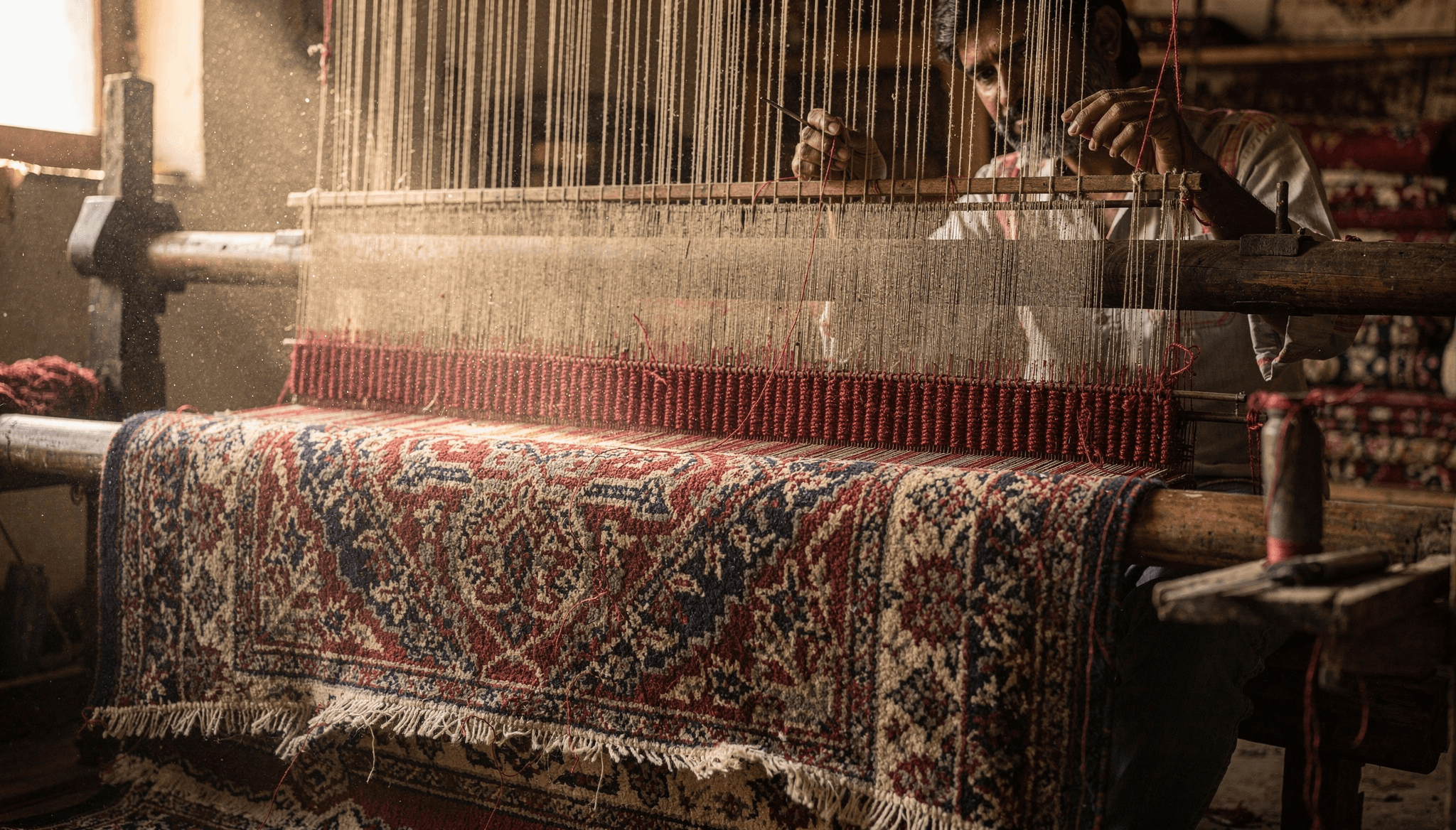
Ask for a genuine rug in Europe and you will almost always get a Persian answer. Isfahan, Tabriz, Nain: these names carry the aura of the original, while India, if it appears in the conversation at all, tends to appear as the land of imitation. That narrative is convenient, and it is wrong. India has been knotting for five centuries, has given the craft a language of its own, and is today the largest exporter of handmade carpets in the world. Roughly 40 percent of the handwoven rugs Germany imports come off Indian looms. It is time the story was told properly.
From the Mughal court to a language of its own
The art of knotting arrived at the Mughal court in the late sixteenth century. The emperor Akbar brought Persian master weavers to Agra, Lahore and Fatehpur Sikri and established court workshops that at first did what court workshops do: continue the Persian canon at the highest level. But within a generation the craft began to speak Indian. The patterns opened toward the plant and animal world of the subcontinent, the palette grew deeper and earthier, and the knot densities of the Mughal era reached degrees of fineness that in places surpassed their Persian models. Pieces from those workshops hang today in the great museums of the world, not as copies, but as a chapter of carpet history in their own right.
With the decline of the Mughals, the courtly craft dispersed into the regions and survived where wool, water and knotting knowledge came together. Through the nineteenth and twentieth centuries it grew into an export landscape that today carries hundreds of thousands of weavers, and with it a range that runs from simple mass goods to pieces that stand comparison with any of the classical provenances.
The regions and their handwriting
Indian knotting is not one style; it is a map of handwritings.
The center lies in the carpet belt of Bhadohi and Mirzapur in Uttar Pradesh, the largest contiguous knotting region in the world, whose carpets carry their own protected geographical indication. The full spectrum of the craft is made here, from robust contract rugs to fine individual pieces; the heartland has its own essay.
Rajasthan, the home of Carpetstory, joins an old weaving tradition to the wool of its desert sheep: long-stapled, robust, made for pieces meant to carry decades. The workshops of Jaipur produced rugs in the nineteenth century that today rank among the country's sought-after collector pieces.
Kashmir stands for the finest end of the scale: silk rugs with densities far beyond half a million knots per square meter, miniature painting in textile form. And Agra continues to build on the legacy of its Mughal workshops, with powerful classical patterns in large formats.
The craft today
What comes off these looms follows a chain of handwork that has changed little in centuries, and every link in it decides the result.
It begins with the wool: long-stapled highland wool, often blended with New Zealand wool for bright, even dye uptake, joined by silk and bamboo silk for luster and drawing. What each fiber contributes is covered in wool, silk and bamboo silk.
Dyeing happens in lots, traditionally with plant dyes from indigo, madder and walnut, whose fine movement across the field no industrial process can reproduce, or with chrome dyes where project precision is required. The art behind it is described in natural dyeing.
Knotting in India is done predominantly with the Persian knot, which allows fine, flowing drawing; what separates it from the Turkish knot is explained in Persian or Turkish knot. And above it all stands the one number that makes the craft measurable: knot density, to which we devote an essay of its own.
Why the reputation lags, and what is true in it
Honesty belongs in this story: the doubtful reputation that occasionally clings to Indian rugs in Europe did not come from nowhere. From the seventies into the nineties, quickly and cheaply knotted copies of Persian patterns flooded the Western market, and the trade gave them a name that echoes to this day: Indo-Persian. It meant goods that looked like Persia and cost like mass production, and that is often exactly what they were.
But that word describes a market segment, not a country. A country does not knot quality; a workshop does. The same region that produces simple export goods brings forth pieces that match the best classical provenances in material, density and finish. The difference lies not in the rug's passport but in the specification: wool, dyeing, knot density, finish, and the question of the conditions and the hands a piece is made by. How to see those differences yourself is covered in handknotted vs machine-made.
What Carpetstory stands for
Carpetstory exists to show the upper end of this spectrum, and to make it verifiable. Every piece leaves the manufactory with documented material, a stated knot density and traceable origin, made in workshops whose conditions we know and disclose; what labels can contribute and what only transparency can is the subject of GoodWeave and certification.
Behind it stands a conviction: India's knotting art does not need a Persian narrative to stand. It needs workshops that deserve their name, and buyers who know what to look for. This journal exists for both.
If you want to put the craft to work in a project, the contract and project guide is the working basis, and for everything else, the direct way to us.