Color Matching to RAL and Pantone: Rugs in Your Specified Color
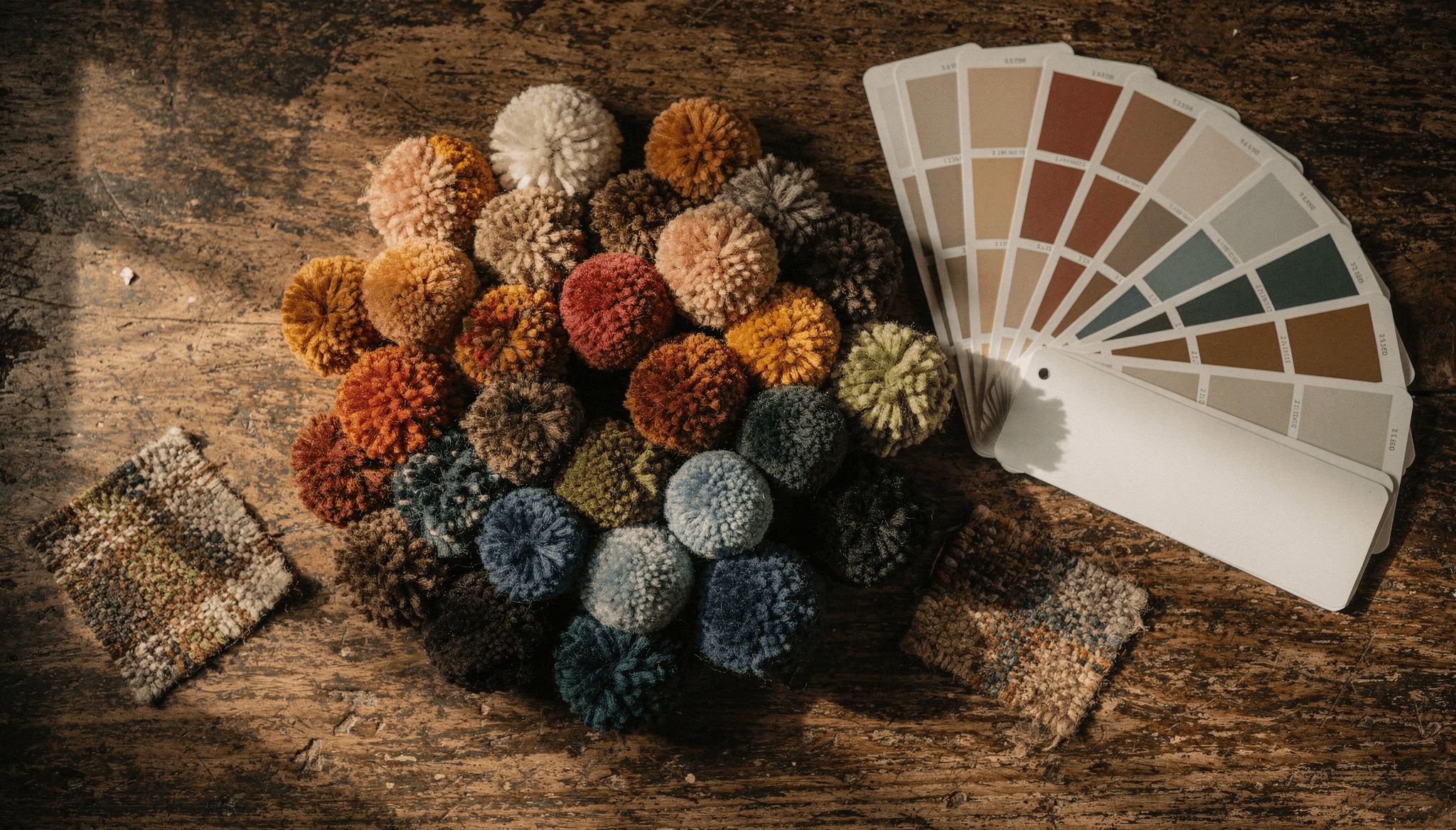
In project work, color is not a matter of taste; it is a specification. A curtain fabric, a natural stone, a wall paint are fixed, and the rug has to join them, precisely and verifiably. On hand-dyed wool this alignment works differently than on industrial goods, and knowing the process is what gets you, reliably, the color the project needs.
Why wool matches differently
A RAL fan shows lacquer on card: a smooth, evenly reflecting surface. Wool is its opposite. The fiber takes color into its depth, refracts light across millions of fine scales, and stands upright in the pile, so every field is made of lit and shaded sides. The same recipe therefore reads warmer, deeper and more alive on wool than on the swatch card.
Add metamerism: two surfaces that look identical in daylight can drift apart under warm-white artificial light. The color code is therefore the starting point of the match, not its result. Approval happens on the material, under the light the rug will live in.
The process in four steps
First, the reference: you name the RAL, Pantone or NCS value, or you send a physical reference from the project.
Second, the dye trial: the dye house produces wool poms matched to it, small dyed yarn bundles in the wool quality of the future rug, on request in two or three nuances around the reference.
Third, the approval: you check the poms in the project context, next to fabrics, timbers and surfaces, under the relevant light, and approve one nuance.
Fourth, production: the entire wool quantity for the rug is dyed in one continuous lot. The field stays consistent within itself; batch-to-batch color drift, familiar from industrial goods, is excluded by construction.
For larger pieces and series, a knotted hand sample in the pile height and knot density of the order is recommended after pom approval. It shows the color as it will stand in the finished piece: in upright pile, with light and pile direction.
References that work
A color code is unambiguous, but it only describes itself. In practice, the physical reference delivers the better result: a piece of the curtain fabric, a leather offcut, a stone tile, a painted sample of the wall color. The dye house then matches to the object itself rather than to its translation into a code. Send what actually occurs in the room; a postcard-sized piece is enough.
Chrome dye or plant dye
The choice of dye type sets how tight the tolerance gets. Chrome-dyed wool, the standard for precise project colors, hits the reference very closely and keeps the field even. Plant dyes from indigo, madder or walnut carry a fine, living variation across the field, the abrash, and age into patina rather than fading. Both are quality, but different kinds: specify chrome for a technically exact, homogeneous color field; choose the plant for depth and life. What plant dyeing means in detail is covered in natural dyeing.
Check the light before production
One minute of effort that prevents complaints: place the poms to be approved at their destination, or under comparable light. North daylight, evening sun, the 2700-Kelvin lighting of a hotel lobby, each shifts the effect. Approve under the light that will count. For projects with a pronounced lighting concept, checking under two light situations is worth it.
Time in the process
Dyed wool poms reach you one to two weeks after commissioning, by air; a knotted hand sample after two to four weeks. Color matching can be pulled fully forward, before size and pattern are final; it is the part of the project that creates certainty early and blocks nothing late. How it fits the overall production timeline is shown in the contract and project guide.
Send us your color reference as a code or material; you will receive an assessment with a proposed matching route within two working days.