Natural Dyeing: How Plant Dyes Give a Rug Its Depth
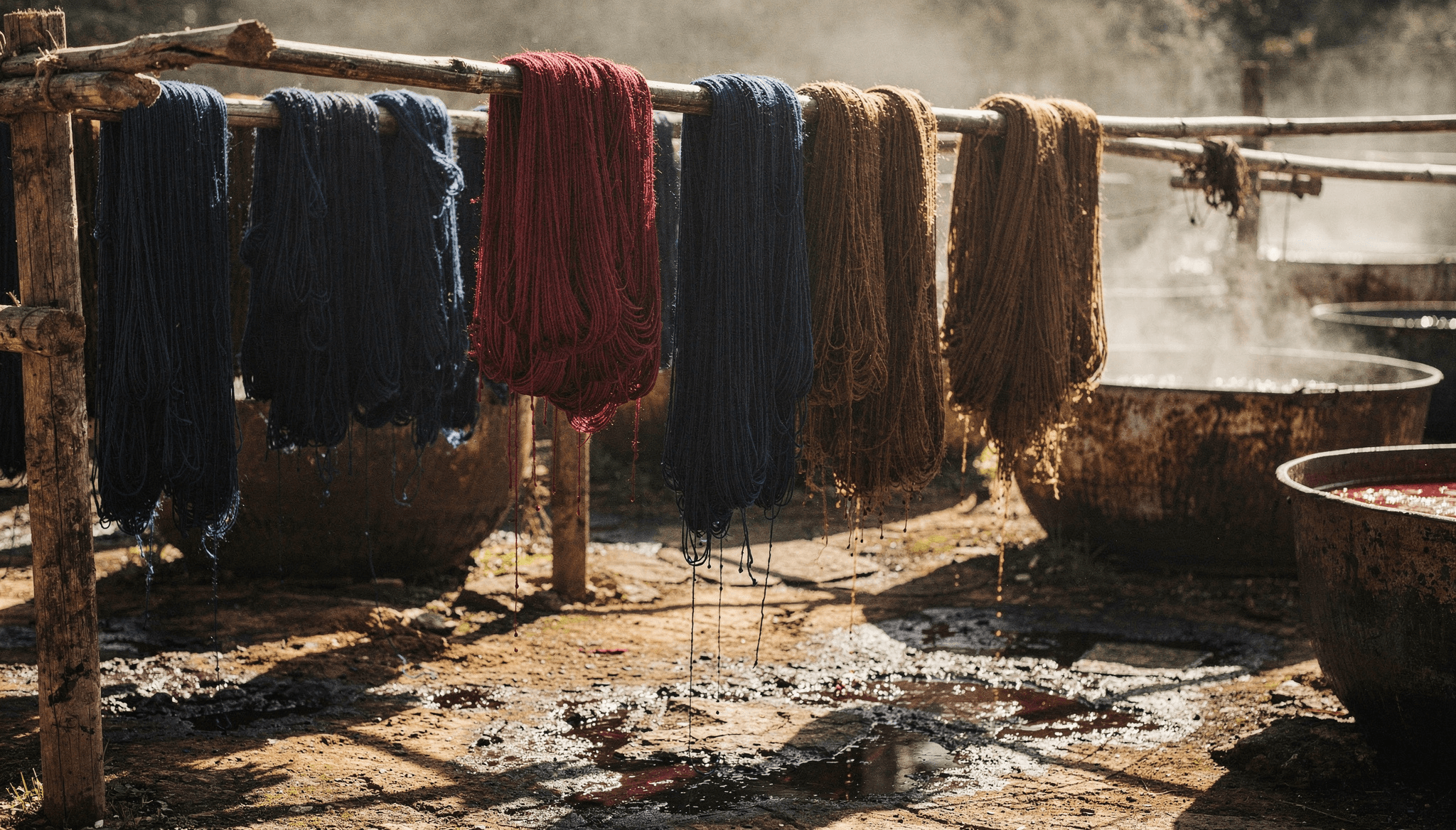
Out of the indigo vat, the yarn comes up yellow-green. Only in the air, before the dyer's eyes, does the transformation happen: the dyestuff oxidizes, and skein by skein the yellow-green tips into that deep blue which people have been coaxing from plants for thousands of years. Watch it once and you understand why dyeing in the knotting regions was never mere process engineering but a craft of its own, with masters of its own. And why its results look unlike anything that comes out of an industrial bath.
The dyestuffs
Four plants carry the canon of rug dyeing, and each brings its own character.
Indigo gives the blue, from a pale sky tone after one dip to a near-black midnight after many. It is the only color of the canon that is not made in the bath but in the air, and its depth grows layer by layer.
Madder, the root of the dyer's plant, delivers the red, and a whole register of it: brick red, warm orange-red, deep wine red, depending on the age of the root, the hardness of the water and the handling of the bath. The maroon Carpetstory carries as its brand color has its craft ancestors in this root.
Walnut husks give the browns and earth tones, warm and unobtrusive, and pomegranate rind the spectrum from yellow to khaki. Mixed and overdyed, these four sources yield nearly every nuance a classical rug needs: green from indigo over pomegranate, violet from indigo over madder.
The craft behind it
For plant dye to hold on wool it needs an intermediary: the mordant, traditionally alum, which bonds with the fiber and chains the dyestuff permanently to it. Mordant first, then dye, in kettles whose handling is experiential knowledge. Temperature, time, water hardness, sequence: a dye house's recipes are its real capital, often passed down generations and nowhere fully written out.
Dyeing happens in lots, the entire wool quantity of a rug in continuous batches, and afterwards the skeins dry in the sun. How these lots are matched to a RAL or Pantone reference in project work is described in color matching.
Abrash: the life in the field
With plant dye, two batches of the same recipe are never perfectly identical, and even within one skein the fiber does not take the dyestuff evenly everywhere. In the finished rug this shows as abrash: fine horizontal shadings, a breathing of the color field that appears and disappears with the light.
Industrial logic would book that as deviation. The logic of the craft sees it the other way around: abrash is the signature of the hand in the material, the mark by which connoisseurs tell plant dyeing from industrial goods, and the reason a plant-dyed field reads as alive where a chemically homogeneous one stays mute. It is no more a defect than the grain in wood.
Aging into patina
The largest difference may only show after years. Early synthetic dyes left dyeing with a bad reputation because they bleached hard and left fields dead. Good plant dyeing ages differently: its tones are broken by nature, composed of many color components, and they change together, slowly and harmoniously. Depth becomes warmth, contrast becomes accord. Collectors call it patina and pay for it; it is the same process that gives good leather or a wooden floor its second beauty.
Plant or chrome: an honest division of labor
Modern chrome dyes are indispensable to the manufactory, and talking them down would be dishonest: where a project demands an exact, homogeneous reference color, they are the right tool, lightfast and precise. Plant dye is the tool for the other goal: depth, life, character that grows with the years. Good houses master both and say openly which serves what.
Ecologically too, the subject deserves a sober sentence rather than a green label: plant dyes come from renewable sources, but mordanting and rinsing happen here as well. In the end, a dye house's environmental record is decided by how it handles water, not by the origin of the dyestuff alone; more on this in our sustainability principles.
What the dyed wool becomes at the loom is told in from design to loom, and the full picture of the craft is drawn in handknotted rugs from India.