Moth Protection for Wool Rugs: Prevention and Treatment
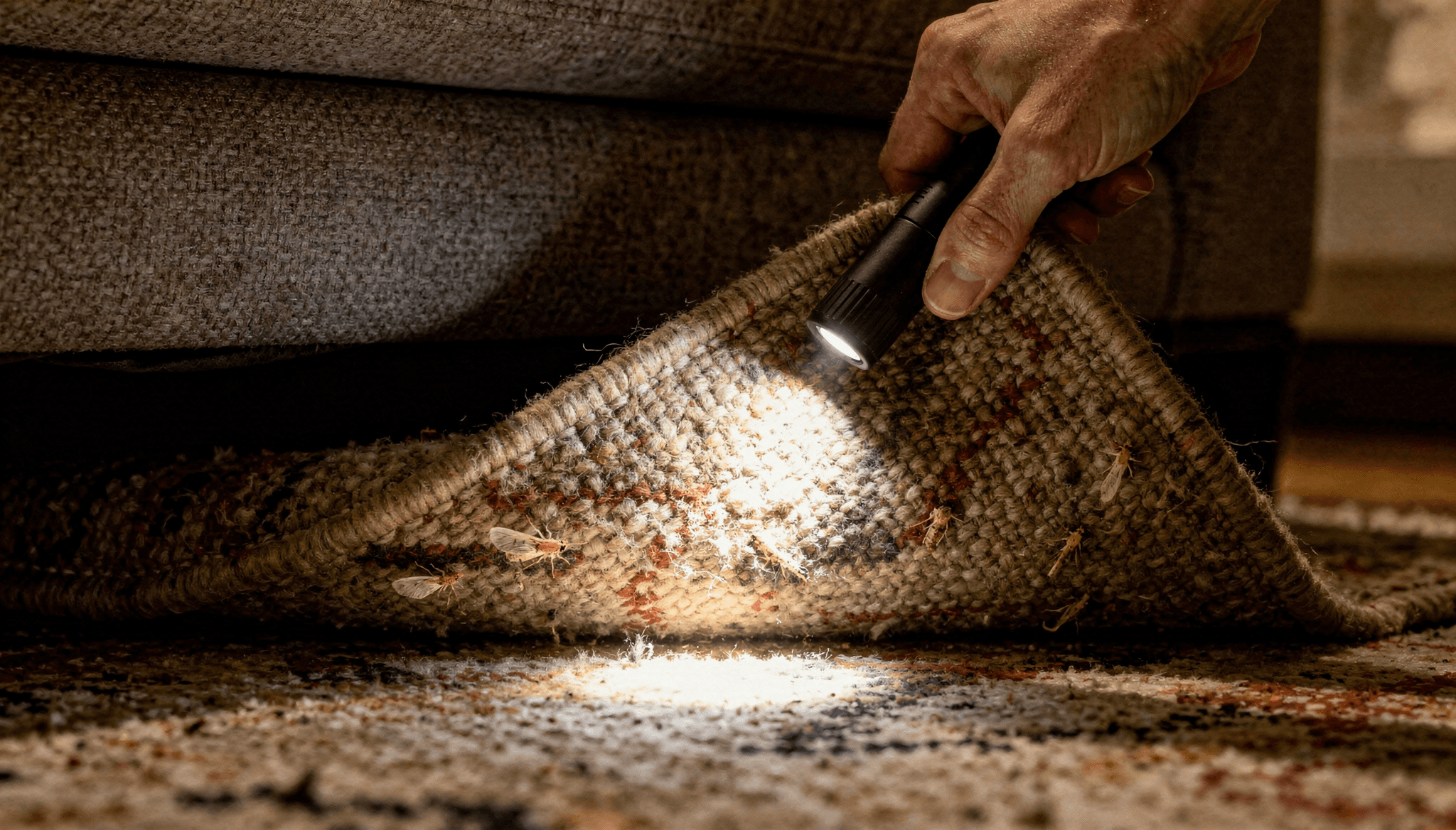
The moth fluttering through the room eats no wool. The danger is its larvae, and they work invisibly: in the dark, in peace, preferably where nobody looks for months. That is exactly why moth protection for a wool rug is not a question of the right chemistry but of the right habits, and exactly why infestation almost always strikes the undisturbed places: under the sofa, under the cabinet, in the stored piece. Know the biology and you are two steps ahead of the animal.
Know the adversary
Two species come into question: the webbing clothes moth, whose larvae eat keratin, meaning wool, silk and hair, and the carpet beetle, whose larvae prefer the same menu. Both lay their eggs where the brood can feed undisturbed, and both avoid light and movement. Soiled wool is especially attractive: skin flakes, food residues and old spills in the pile are the side dishes that make a rug truly interesting. A clean, regularly moved piece is a poor nesting site for both species.
Spotting infestation early
The signs, in order of reliability: bare or thinned patches in the pile, almost always in covered areas; sand-like granules, the droppings of the larvae, tellingly in the color of the eaten wool; fine silken tubes or threads at the pile base and on the back; empty larval casings. Flying moths are the latest of all signs, because where they fly, a generation has already done its work.
The routine therefore includes a deliberate look: at the half-yearly rotation of the rug described in the care guide, check the covered areas and the back, especially the zones under furniture.
Prevention: movement beats fragrance
The most effective prevention costs nothing extra, because it consists of good basic care. Regular vacuuming removes eggs and larvae before they settle, and the disturbance itself drives them off; include the edge zones and the areas under furniture, shift furniture occasionally, and once or twice a year lift the rug and vacuum both the floor and the back. Light and air do the rest: what is regularly moved, walked on and lit, the moth practically never infests.
Lavender and cedar deserve an honest sentence: they deter adult moths while the scent is fresh, and they kill nothing. As companions in the wardrobe or the storage wrap they are harmless and pleasant; as a protection concept they are none. More useful are pheromone traps, though as an early-warning system, not a treatment: they catch male moths and so indicate that something is flying in the room, long before damage becomes visible.
Treating when it has happened
Once infestation is confirmed, speed counts, because larvae keep eating while you deliberate. First vacuum thoroughly, both sides, all covered areas, and dispose of the vacuum bag outside the house immediately, because it now contains living brood. Then the temperature treatment: smaller pieces go tightly sealed into the freezer for several days at minus 18 degrees Celsius or below; frost reliably kills eggs, larvae and moths and spares wool and dyes. For large rugs and serious infestation, the specialized workshop is the right path, covering all stages with washing and suitable treatment; do-it-yourself insect sprays are a risk to the dyes on hand-dyed wool and often never reach the pile base at all.
Look beyond the rug: moths do not distinguish between carpet, sweater and curtain. In case of infestation, check the room as a whole, inspect textiles, vacuum cracks and skirtings, and leave a pheromone trap hanging afterwards as a control.
Storing without an invitation
Most serious infestations happen in storage, and almost all for the same reason: stored uncleaned and never checked. The rules are in the care guide and apply doubly here: store only cleaned, rolled, wrapped breathably, dry and dark, with cedar or moth paper as a companion and a check every few months. A piece kept this way survives even years in storage unharmed.
Should an infestation have left traces, that is no farewell for a handknotted rug: bare patches can be reknotted, knot by knot, as the guide to repair and value retention shows. Talk to us before giving up an infested piece; more are saved than you would think.