Rug Care: How a Handknotted Rug Outlasts Generations
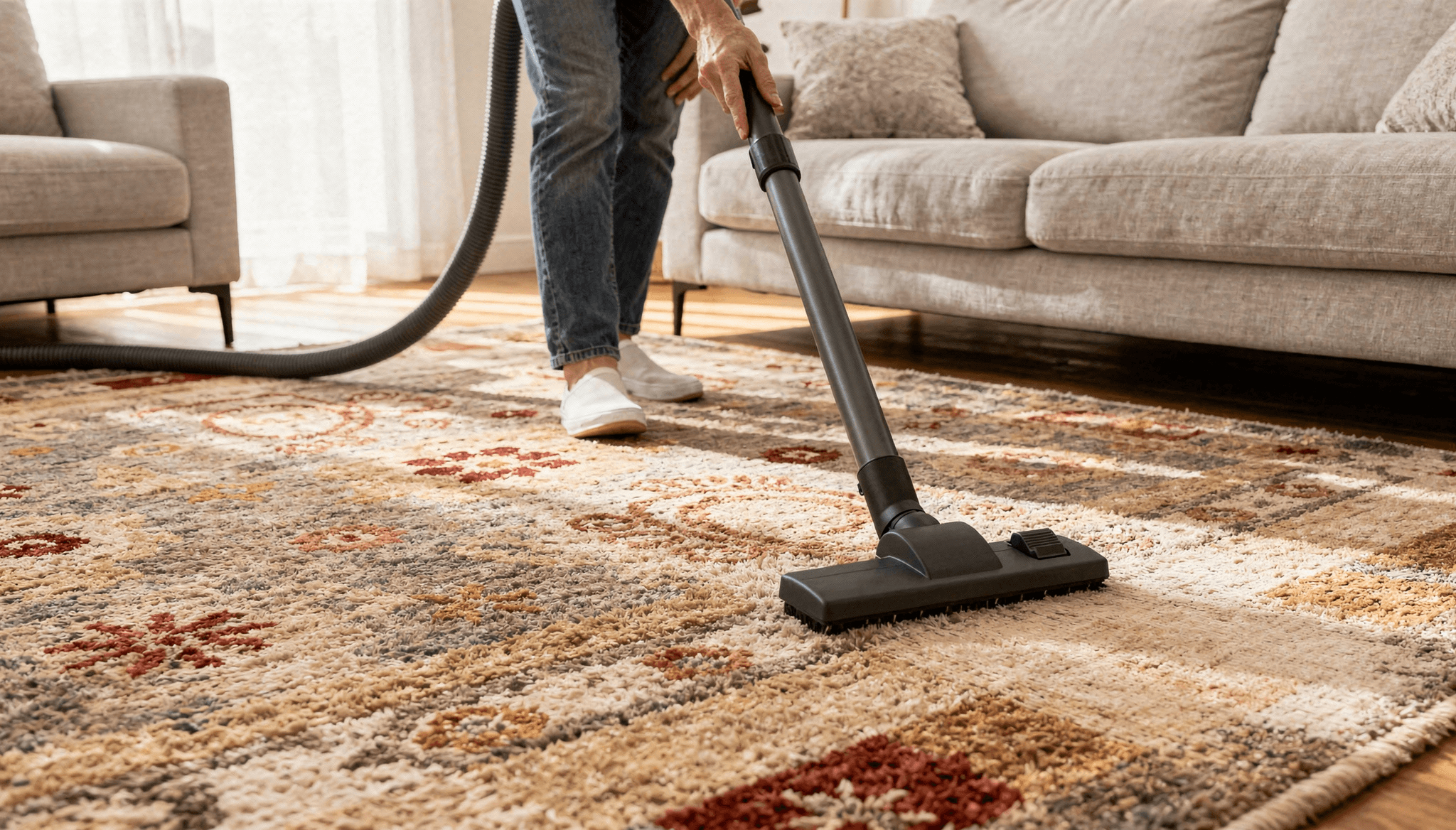
A handknotted rug asks for little, but it asks for it regularly. That is the whole philosophy of its care: no effort in crises, but a calm rhythm that keeps crises from arising in the first place. Keep the following routines and you give a good piece what it was built for: decades.
The weekly routine: vacuuming, done right
Dirt is the real adversary. Sand and fine grit migrate to the pile base and grind there with every step; regular vacuuming lifts them out before they can work. Done right means: with a smooth nozzle, without a rotating brush, because the roller of a brush head tears at fibers and fringes, at moderate suction and in the direction of the pile. In used rooms, one or two passes a week are enough, fewer in quiet rooms. The fringes are left out and instead combed flat by hand from time to time. Once or twice a year, look underneath: lift the rug, vacuum the floor and the back, because what gathers there is seen by no one and works all the same.
The yearly rhythm: rotation and light
No room wears evenly. Walk paths, favorite spots and sunny windows write themselves into the pile over the years if allowed to. The countermeasure costs two minutes: turn the piece 180 degrees every six to twelve months so that footfall and light wander. Permanent direct sun on the same spot will bleach any dye over time; curtains, a light UV film on the glass, or simply the rotation keep the process slow enough to become patina rather than damage. What separates patina from fading is explained in the essay on natural dyeing.
The emergency: spills
For spills, one iron rule applies: fast and gentle beats slow and thorough. Blot liquids immediately with a white cloth or kitchen paper, never rub, work from the edge toward the center, follow up with a little cold water if needed and blot dry. No household cleaners, no home-remedy experiments; anything beyond blotting belongs to the cleaning guide, which walks through the most common cases one by one.
The foundation: underlay and furniture
An underlay belongs beneath every free-lying piece: it prevents shifting and creasing, cushions footfall and measurably reduces abrasion at the pile base. Under furniture feet, coasters spread the pressure, and shifting heavy furniture by a few centimeters now and then spares the pile permanent compression marks. In hard-used contract settings both are part of the specification; the connections are shown in the guide on durability.
The multi-year rhythm: the professional wash
Every three to five years, sooner under intensive use, a handknotted rug belongs in a professional hand wash. It releases what no vacuum reaches, restores color and hand, and is at the same time the best occasion to have fringes, edges and pile checked by an expert. The choice of workshop matters: a wash house specialized in handknotted rugs, not machine cleaning with rotary brushes or harsh chemistry. Small damages noticed there are best fixed at once; why early repair is the affordable kind is explained in repair and value retention.
The pause: storing correctly
If a piece is to be stored, four rules decide its condition afterwards. First: store only cleaned, because residues in the pile are an invitation to pests. Second: roll, never fold; fold lines break warp and pile. Third: wrap breathably, in cotton or specialist fleece, not airtight in plastic, where residual moisture condenses. Fourth: store dry, dark and lying flat, and check every few months. The most important storage enemy has a guide of its own: moth protection.
That is all it is. Vacuum without a brush, rotate, blot fast, have it washed every few years, store clean: five habits that turn a good rug into an heirloom. For questions about a specific piece, we are easy to reach, even if it is not one of ours.