Repair and Value Retention: Why Genuine Rugs Are an Investment
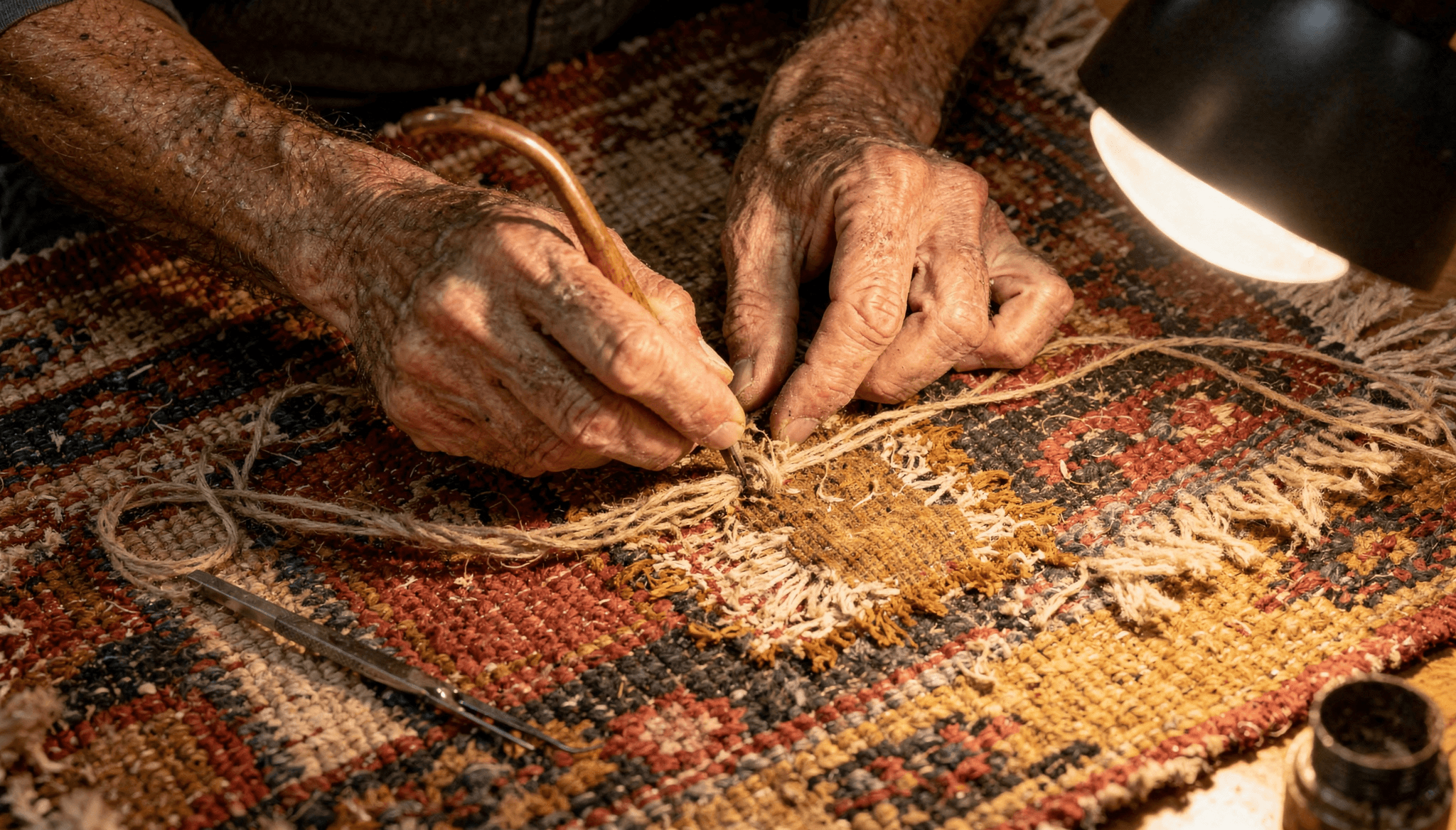
One sentence separates the handknotted rug from almost everything else that lies on floors: it is fully repairable. Every spot of the piece consists of individual knots, and what consists of individual knots can be rebuilt knot by knot, after fifty years just as after five. This guide shows what restoration can do, why timing decides the cost, and what "value retention" honestly means, without the investment prose this trade likes to overdo.
What can be repaired
Almost everything, and that is meant literally. Loosened fringes are resecured, worn end finishes newly laid, abraded selvedges freshly wrapped. Holes, burn marks and moth damage are reknotted: the restorer rebuilds warp and weft at the damaged spot and then knots in with wool matched in color and grist, in the original knotting technique, until the spot disappears into the pile. Even structural interventions are possible, from straightening warped pieces to professionally reducing a rug that must fit a new floor plan.
The limit runs not through the piece but through the construction: what is described here applies to knotted goods. Machine-woven and tufted rugs are structurally barely repairable, one of the quiet differences soberly calculated in handknotted vs machine-made.
Early is affordable: the logic of the edges
Rugs die from the edges inward. Fringes are not decoration but the ends of the warp threads on which the entire piece is knotted; the edges are the wrapping that holds the outermost knot rows. Once fringes loosen or a selvedge abrades, the knot rows begin to release, imperceptibly at first, then visibly, and with every lost row the eventual intervention grows.
From this follows the most important rule of the subject: have edge damage secured at once. Early securing of fringes and edges is a small routine job; the same spot one or two years later is a partial restoration. The regular professional wash described in the care guide is therefore also an inspection date: a good workshop sees the beginning damage before it becomes one.
Value retention, honestly calculated
A lot of nonsense is written about rugs as "investments," so the sober version first: most rugs, including very good ones, are not speculation objects, and anyone primarily chasing returns is better served in other markets.
The honest calculation is a different one, and it comes out clearly in favor of the knotted piece. First, use value over time: a piece that carries for decades and stays repairable costs, per year of its life, a fraction of what the chain of purchase, wear and replacement adds up to with industrial goods. Second, residual value: good handknotted rugs have a functioning secondary market, because substance and repairability keep them tradable; machine goods after some years have a disposal date, not a listing. Third, the exception upward: outstanding and rare pieces can appreciate, and the antique market exists at all only because this craft outlasts generations. That is the correct order: use first, then retention, last the possibility of more.
Value retention also involves paper: having a piece's origin, material, knot density and condition documented helps with insurance, inheritance and sale alike. What such a file contains is described in the essay on traceability; at Carpetstory it ships with the piece.
The right hands
A restoration is as good as the workshop that performs it. Professional means: matching wool, matched dyeing, the original knotting technique, and the restraint to replace only what must be replaced. Amateur repairs, glued-on patches and machine oversewing reduce the value they are meant to save. Ask to see reference work, and for larger interventions get a second assessment; a serious workshop has no problem with that.
If a piece is lying with you whose condition concerns you, send us photos of the front, the back and the damaged spot; you will receive an honest assessment of whether, how and in roughly what range the damage can be repaired, even if the piece is not one of ours.