Handknotted or Machine-Made: The Difference You Can Feel
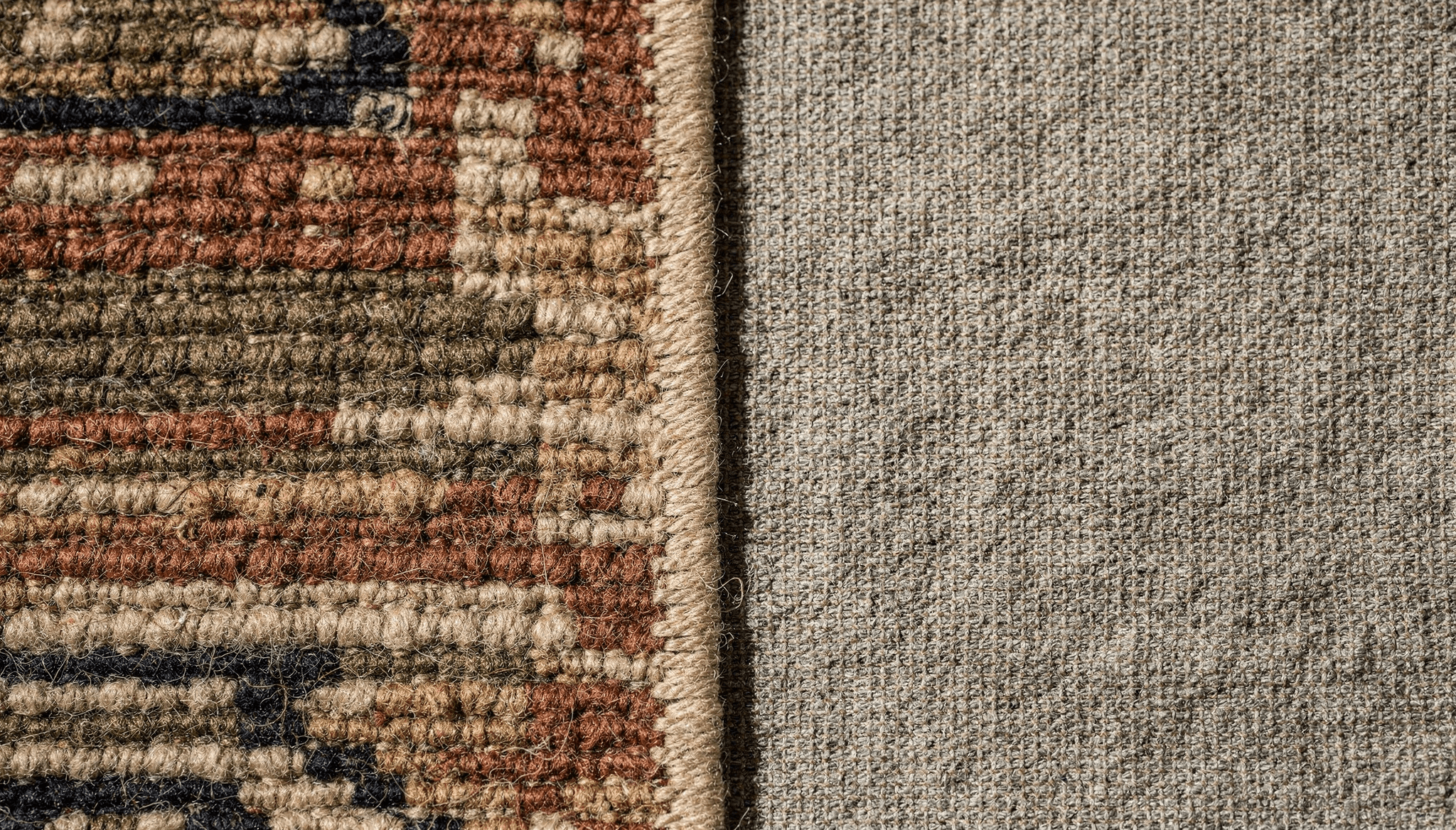
Two rugs can look the same at first glance and still be two entirely different objects. One came into being over weeks and months, knot by knot, by hand; the other was thrown off a weaving machine in minutes; and a third, which likes to sail between the two, was shot into a backing cloth with a tufting gun and glued on the reverse. Which one lies in front of you decides lifespan, repairability and value. Here is how to tell the three constructions apart, and how to judge them honestly.
Three constructions
In a handknotted rug, every knot is tied individually around two warp threads, compacted and beaten down row by row. The piece carries itself: pile, warp and weft are one inseparable structure. How that structure comes to be is shown in from design to loom.
Machine-woven rugs are produced on weaving and knitting lines that bind the yarn into a technically exact carrier structure. The result is uniform, fast and cheap, frequently in synthetic fibers or wool blends, and of perfect regularity in both pattern and dimension.
Hand-tufted rugs are the hybrid: yarn is shot by hand or semi-mechanically through a stretched backing cloth and fixed on the reverse with latex, covered by a glued or sewn-on fabric back. From the front, this can look deceptively like knotting. Structurally, the piece is held together not by knots but by glue.
What that means over the years
Construction decides how a rug ages.
The knotted rug wears like a natural material: slowly, evenly, repairably. Individual spots can be reknotted, edges re-wrapped, fringes renewed, because every spot consists of individual, accessible knots. Cared for, such a piece carries for decades and often outlasts its first generation of owners; what restoration can do is covered in repair and value retention.
Machine goods age as industrial products: synthetic pile loses spring and luster, and repair is technically barely possible and economically pointless. Five to fifteen years is the usual range depending on fiber and use; then comes replacement.
Tufting ages through its weakest point, the glue. Latex embrittles over the years, the piece begins to shed, the back chalks, the pile loosens. Ten to twenty years is a realistic frame, and little of it can be repaired.
The economics part ways too: machine and tufted goods are consumer products with the usual downward value curve. A good handknotted piece holds its value, and exceptional pieces gain.
When each construction is legitimate
Honesty cuts both ways: machine goods have their rightful place. For temporary fit-outs, rental properties, fast trends or tight budgets they are the sensible choice, and tufting delivers a lot of look for little money. It becomes a problem at exactly one point: when tufted or machine goods are sold with the vocabulary and the prices of handknotting. "Handmade" on the label of a tufted rug is technically not even a lie, and that is precisely what the business model is built on.
The protection is a practiced eye: back, fringe and pile base reveal the construction within a minute. The full seven-step check is in identifying a genuine handknotted rug, and what the knot count contributes is explained in the essay on knot density.
In the end, the choice of construction is a choice of time horizon. Buying for the next five years means buying machine. Buying for the next thirty means buying knots. We are happy to help you place it, including when the honest answer is that your purpose does not call for a handknotted piece at all.