How to Identify a Genuine Handknotted Rug: Seven Checks
"Handmade" is a stretchy word. It appears on machine-woven rugs with hand-knotted fringes and on tufted goods alike, and the price difference between those pieces and true handknotting is a multiple. Anyone buying, whether for a project or their own home, should be able to verify the construction themselves. Seven checks are enough, and none of them needs a laboratory.
1. The back
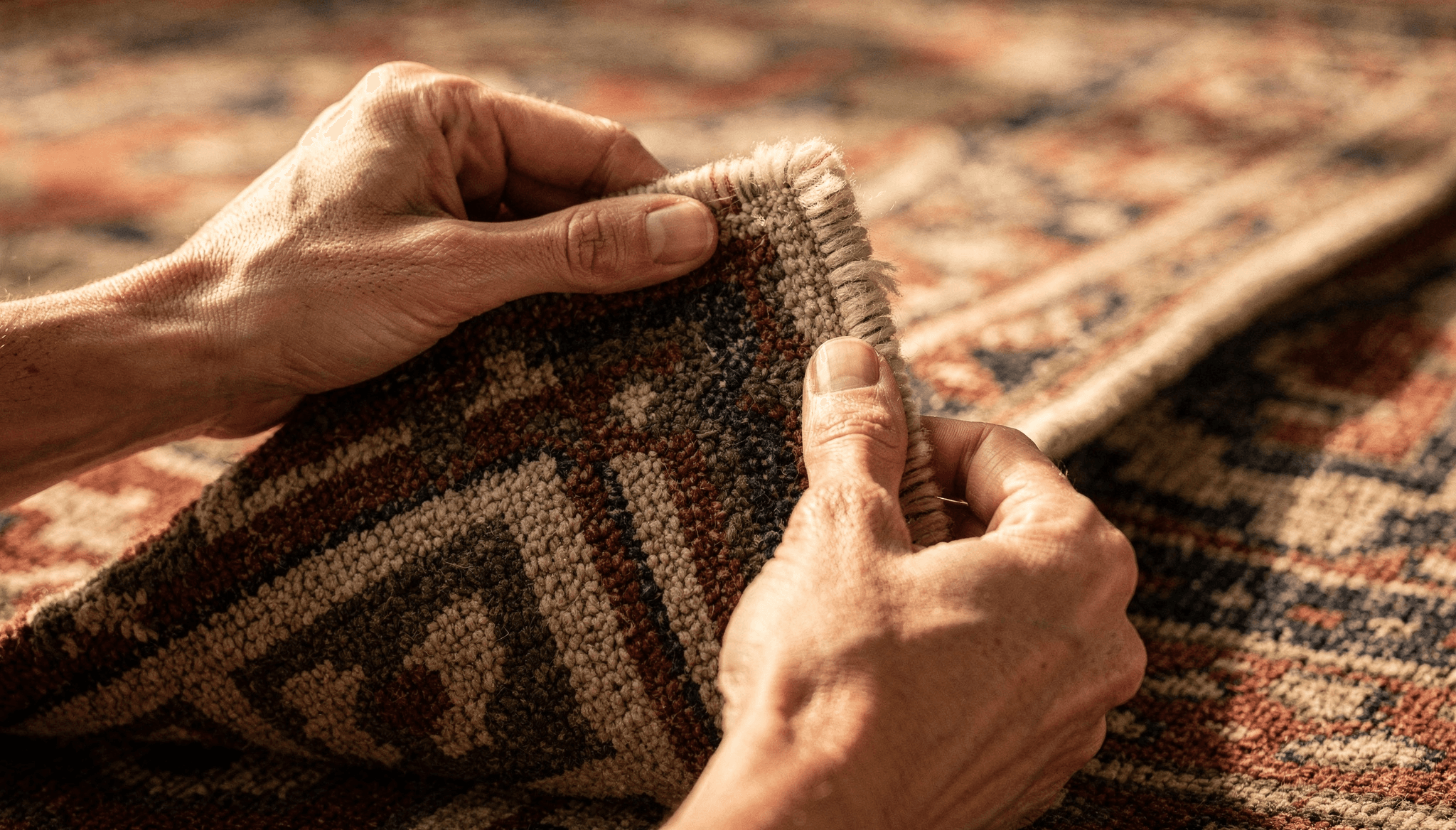
The most reliable look first: fold back a corner. On a handknotted rug the pattern appears on the reverse as clearly as on the front, knot by knot, with the slight irregularity of living handwork. Machine goods show a technically exact grid instead, often with visible weft threads running across the pattern. And if you see a latex layer or a sewn-on cloth back, you are not holding a knotted rug but a tufted one.
2. The fringe
On a genuine piece the fringe is not decoration but construction: the ends of the warp threads on which the entire rug is knotted. It runs out of the piece. Sewn-on or glued fringes, recognizable by a seam across the short end, are the sure sign of industrial production imitating authenticity.
3. The pile from inside
Bend the pile apart at one spot. On a knotted rug you will see individual knots sitting in rows at the base, each tied by hand around two warp threads. On machine goods the yarn disappears into a uniform structure; on tufted goods, into a layer of glue.
4. Irregularity as signature
Lay a ruler along the edge, compare two pattern repeats, measure both diagonals. A handknotted rug is never quite perfect: the edge breathes slightly, the medallion sits a touch off-center, the repeat varies. These deviations are not defects but the handwriting of months of human work. Perfect symmetry in pattern and dimension has exactly one source, and that is the machine.
5. Selvedges and edges
The long edges of a knotted rug are wrapped by hand with yarn, firm and slightly irregular. Machine-finished edges look sewn by comparison: perfectly even, often with a visible stitch pattern.
6. Material and hand
True handknotting works with natural fibers. Wool feels warm, slightly waxy and springy; press the pile down and it recovers. Silk is cool, heavy, and glows from depth, not just at the surface. Synthetics feel slick, almost squeaky against the finger, and stay flattened longer after pressure. Touch does not replace analysis, but it exposes the crudest mislabeling.
7. Price plausibility
Finally, the simplest calculation: a fine rug of two by three meters contains hundreds of thousands of hand-tied knots, which means months of work, plus wool, dyeing, washing and finishing. A price out of all proportion to that tells its own story. What knot counts say about effort and value is explored in understanding knot density; the construction differences in detail are covered in handknotted vs machine-made.
If you also want to know the conditions under which a piece was made, the guide to GoodWeave and certification puts the relevant labels in order.
At Carpetstory, verification is part of the product: every piece leaves the manufactory with documented construction, material and origin. Ask us your questions; a maker has nothing to hide from the back of a rug.