Understanding Knot Density: Why the Knot Count Decides Quality
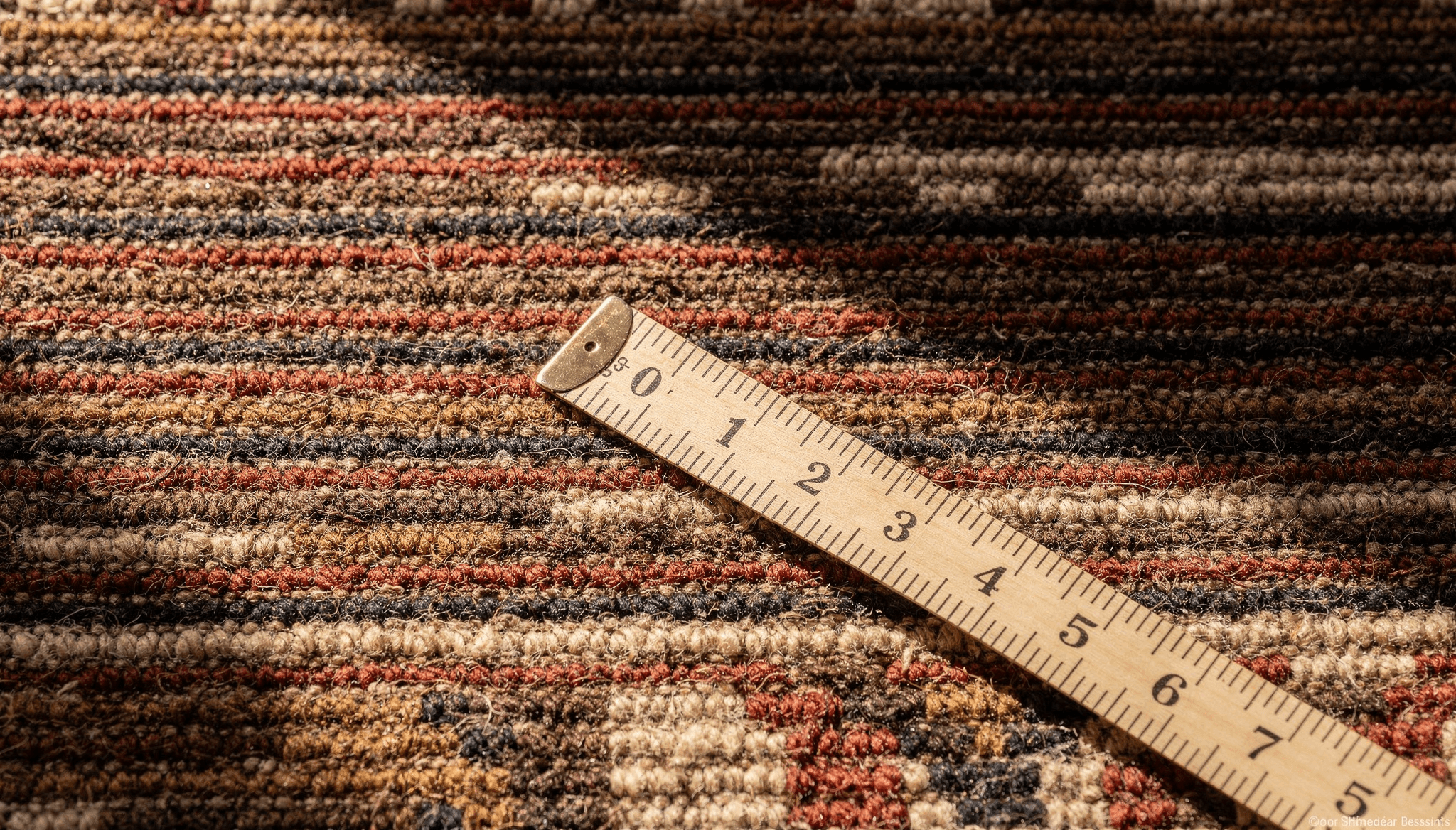
A knot takes three seconds. A practiced hand picks the thread, loops it around two warp threads, pulls tight, cuts, and on. Three seconds, several thousand times a day, many millions of times per rug. A single square meter of a fine piece holds more knots than a person could count in weeks, and this one number, the knot density, is the closest thing to an objective measure of quality this craft possesses. It is also its most misunderstood and occasionally abused figure. Reason enough to understand it properly.
What the number measures
Knot density is the number of knots on a unit of area, in Europe usually per square meter, in international trade often per square inch. It is counted on the back, where every knot shows as a small square of color: knots across ten centimeters of width times knots across ten centimeters of height, scaled up to the square meter. The trade keeps its own shorthand for standard qualities alongside, but they all translate into the same currency: knots per area.
For rough orientation: robust qualities begin around 100,000 knots per square meter, fine pieces reach 250,000 and more, and the silk rugs of Kashmir push the number far past half a million. The scale is open at the top; toward the bottom, at some point, begins the territory where a pattern is merely claimed.
What density does
The simplest way to understand knot density is as resolution. A rug is an image rendered in knots: every knot is a pixel, and the more pixels sit on the field, the finer the drawing. Straight lines and large color fields manage with few points. But a curving vine, a script, a gradient, a medallion with a clean contour need resolution, exactly as on a screen. Where density is missing, curves staircase, details blur, elegance slips into suggestion.
The second contribution is stability. The closer the knots stand, the less room the pile has to shift under load, and the harder it is for grit to reach the pile base, where it works like sandpaper. Density is therefore also a durability figure, which makes it relevant for hard-used areas; the specification side of this subject is covered in durability in contract use.
And finally, body: a densely knotted piece lies heavier, drapes fuller, feels more compact in the hand. You can almost hear it when you fold back a corner.
Where more density adds nothing
Here the sales pitch ends and the consulting begins: high knot density is not an end in itself. A deliberately reduced design, a calm color field, a powerful geometry do not need half a million knots; their effect comes from material, color and proportion, not resolution. Whoever has such a piece knotted at museum fineness pays months of labor for a difference no one will see.
The honest rule: density follows the design. Fine, curved, detailed drawing demands high density. Calm, planar, geometric designs stand best at medium density, more robust, more economical and identical in effect. A good house will also tell you when less is enough.
The number and the price
Why density moves the price so directly is shown by simple arithmetic. Doubling the knot count essentially doubles the handwork in the piece: twice as many three-second movements, twice as many weeks at the loom. Material, dyeing and finishing grow with it, but the driver is time. That makes knot density the most effective lever of budget control, more effective than size; a principle that becomes a specification rule in our contract and project guide.
Where the number lies
A metric that moves prices invites invention. Three things are worth knowing.
First, the jufti knot: tie the knot around four warp threads instead of two and the work is halved, while the field still looks filled at first glance. The piece loses density, sharpness and durability, and on the back it betrays itself through conspicuously wide knot squares.
Second, flattering claims: numbers from a sales conversation do not replace counting. The back does not lie; ten centimeters of measuring tape are enough.
Third, confusing density with quality: the knot count is necessary information, not sufficient. Coarse wool, careless dyeing or an indifferently sheared pile make no good piece out of high density either. How to check the construction as a whole is covered in identifying a genuine handknotted rug.
Why we state the number
Carpetstory states the actual knot density for every piece, countable on the back. Not because the number says everything, but because it is the beginning of every honest disclosure: it makes visible the work that otherwise disappears into the pile, millions of three-second decisions that together make a piece built to carry decades. A craft that can be measured has no reason to fear comparison.
What the hands behind these numbers achieve, and where the skill comes from, is the bigger picture: handknotted rugs from India.