From Design to Loom: How a Custom Rug Comes Into Being
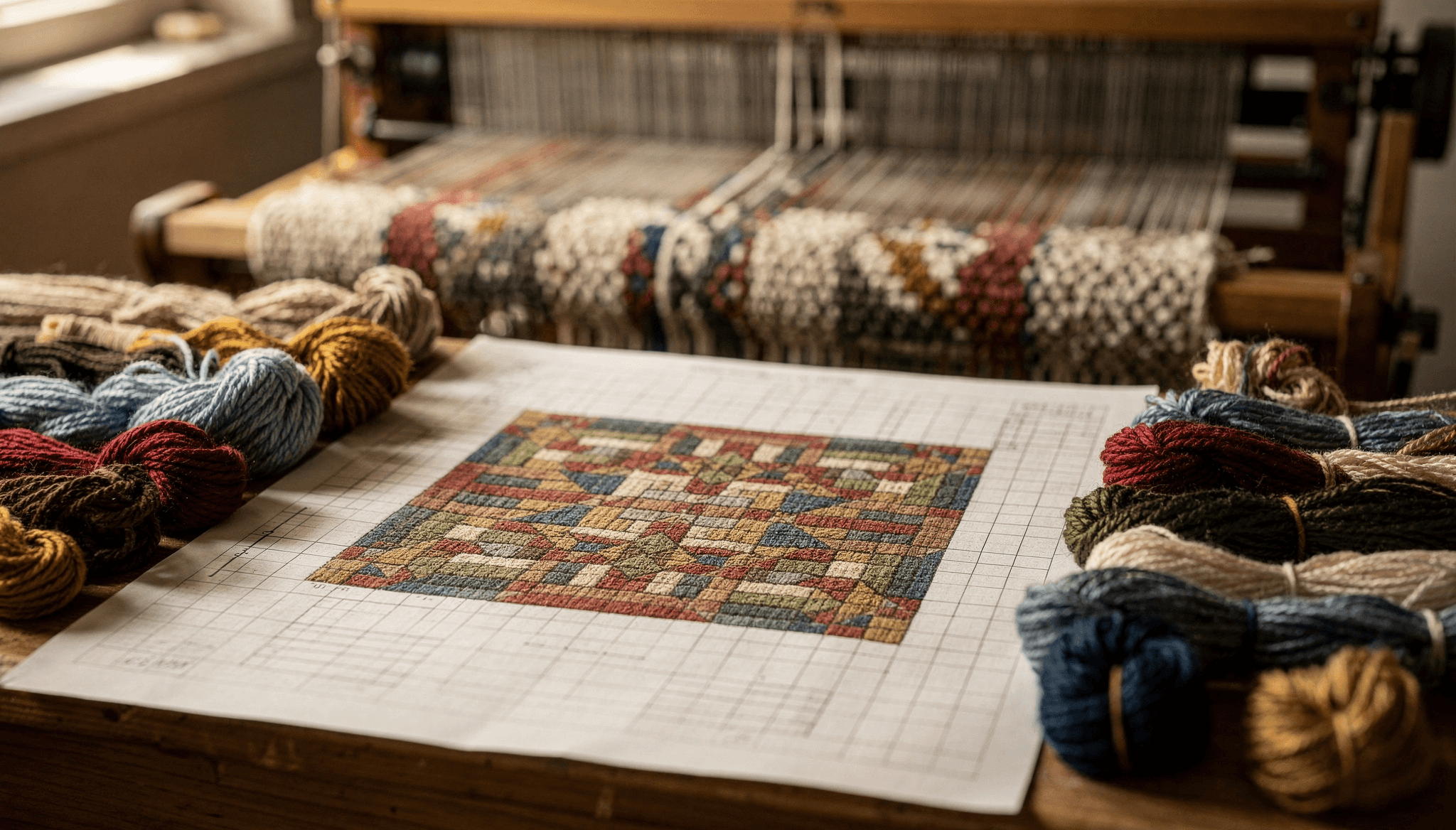
Between a sketch and a finished rug lie six stations and several thousand hours of handwork. Knowing them explains two things: why a handknotted piece takes its time, and why every one of those weeks is visible in the rug at the end. Here is the path, station by station.
First station: design
It begins with a direction, not a finished picture: a reference from the project, a sketch, a historical motif, a plain color field. From this comes the design to scale, with dimension, shape, color placement and pile height. For custom sizes and shapes, the floor plan enters here; what is possible is covered in made to measure.
Second station: the knot plan
The design is translated into the language of the weavers: the knot plan, called the naksha in the workshop. On grid paper, every square stands for exactly one knot in exactly one color. A rug of two by three meters in fine quality becomes a plan of hundreds of thousands of fields, hung at the loom and worked through row by row. Here, at the latest, a pattern proves whether it is thought through as craft; a good plan is half the precision of the finished piece.
Third station: wool and dyeing
In parallel, the material is prepared. The wool is sorted, spun and dyed to the approved color reference, each color in one continuous lot for the entire piece, so the field stays consistent within itself. How matching to RAL, Pantone or material references works is described in color matching.
Fourth station: at the loom
Now the longest stretch begins. The warp is set on the loom, taut as a string instrument, and then the rug grows: knot by knot, row by row, each row compacted with a weft thread and beaten down with the comb. A practiced weaver ties several thousand knots a day; in fine qualities the piece still grows only a few centimeters per week. Eight to sixteen weeks of knotting is the honest range depending on size and density, and on request we document this stretch with photos from the loom.
Fifth station: washing, shearing, finishing
What comes off the loom is a raw rug: dense, dull, the pile uneven. Finishing makes it the final piece. The wash releases dust and residue and brings out the natural luster of the wool. Shearing brings the pile by hand to the specified height and sharpens the drawing. The piece is then blocked and dried so it lies flat and holds its dimension, and finally edges and fringes are finished by hand. None of this is cosmetic; together these steps decide feel, depth and dimensional accuracy.
Sixth station: inspection and shipping
Before shipping comes acceptance: dimension against the production drawing, color against the approved sample, pile, edges and back against our own standard. The piece is then rolled, packed tear-resistant and begins its journey; routes, times and customs questions are covered in direct import.
In total, 16 to 24 weeks typically lie between approved design and delivery. That is not slowness; it is the actual duration of handwork meant to last for decades. The full timeline with all reference figures is in the contract and project guide.
Send us your design idea, as a sketch, reference or moodboard; you will receive an assessment of execution, timeline and budget range within two working days.