Cleaning Handknotted Rugs the Right Way: A Care Guide
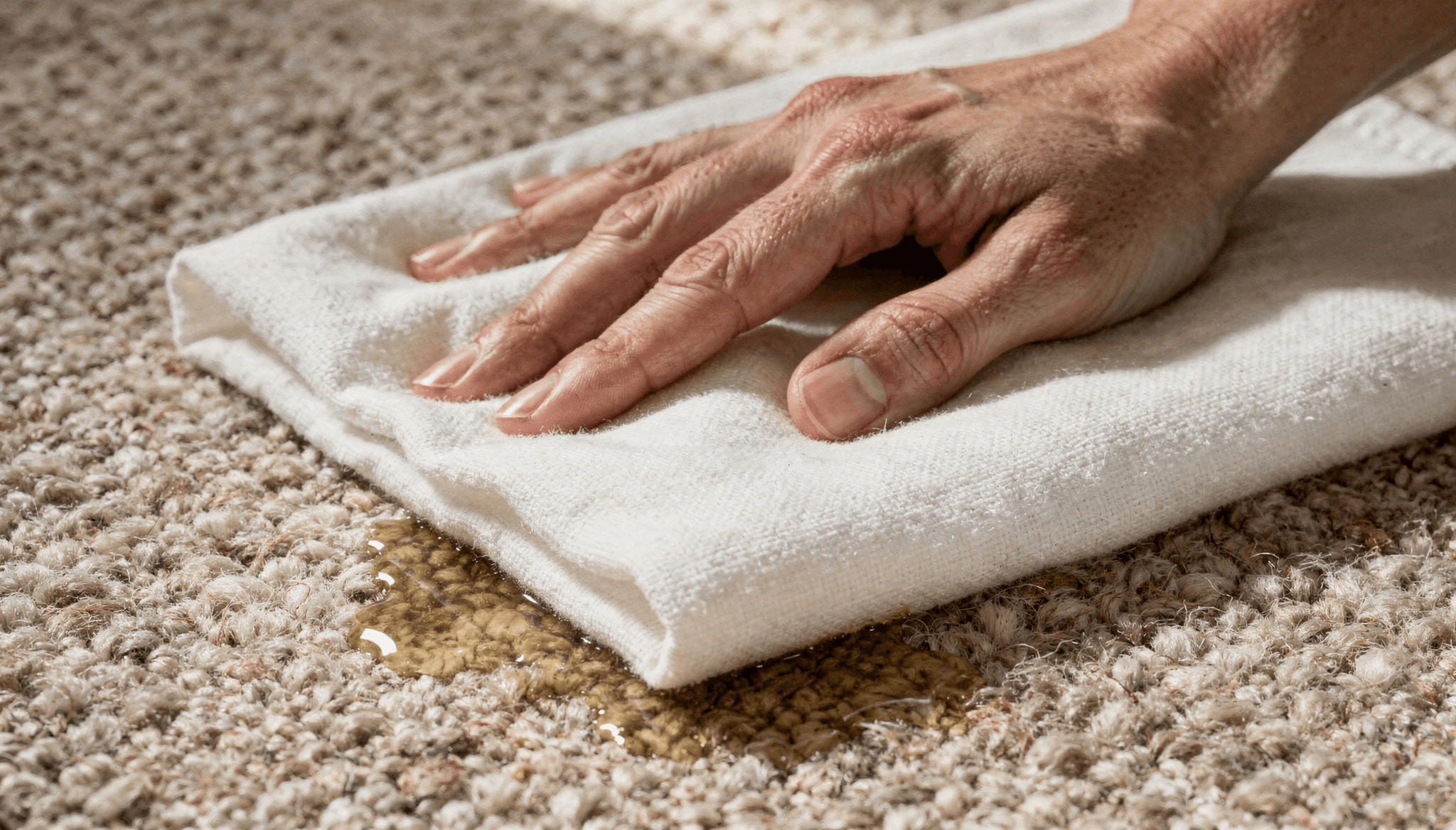
Most rug damage is caused not by stains but by their treatment. A spilled glass is rarely a problem; the rubbing, scrubbing and experimenting afterwards is one. This guide sorts the most common cases, from the first-response protocol to the question of when a case belongs in professional hands. It assumes the basic routine of vacuuming and rotating, which is covered in the care guide.
The protocol for everything spilled
Four steps that apply to almost every fresh stain. First: act immediately, because what does not soak in does not have to come out. Second: blot, do not rub, with a white cloth or kitchen paper; rubbing drives the stain deeper and roughens the pile. Third: work from the edge toward the center so the stain does not travel. Fourth: follow with a little cold or lukewarm water, blot dry, and let the spot dry flat in the air, without a hairdryer and without a radiator.
Before any treatment that goes beyond water comes the colorfastness test: dab a hidden spot with a damp white cloth. If the cloth takes on color, home treatment ends there; hand-dyed wool, vegetable-dyed above all, can bleed, and a bled pattern is the most expensive stain of all. Why these dyes behave that way is explained in the essay on natural dyeing.
The most common cases
Red wine, coffee, tea: the protocol, nothing else. The salt myth should be retired; salt can attack dyes and tends to set the stain rather than draw it, and white wine on red wine is folklore with double the damage.
Grease and oil: first lift off solids carefully with the back of a spoon, then blot. If that is not enough, dilute a mild pH-neutral wool detergent heavily, dab sparingly, follow with clear water, let dry. If a shadow remains, do not escalate; note it for the next professional wash.
Wax: let it harden fully, speed it up with ice in a bag, then break and lift it off carefully. Residues belong in the specialist workshop; iron tricks on wool pile end in shiny patches more often than in success.
Chewing gum: freeze, break, lift. What stays in the pile, the specialist dissolves.
Pet accidents: blot quickly and generously, dilute heavily with cold water and take it up again, several times. Urine is doubly delicate because it can shift dyes and leave odor; for anything beyond one small mishap, the specialized wash is the right address, and soon.
What never belongs on a handknotted rug
The forbidden list is short and absolute. No rotating brushes, neither on the vacuum nor on cleaning machines. No steam cleaner and no hot wetness; they release dyes and felt wool. No stain sprays, all-purpose cleaners or oxygen bleach. No soaking through to the foundation, because what stands at the bottom dries badly and leaves rings. And no drying on the radiator; heat fixes whatever still sits in the pile.
Two materials demand extra restraint: silk and bamboo silk. Both react sensitively to wetness and friction, and bamboo silk loses strength when wet; here, home treatment ends after blotting, and everything further goes to the specialist. The background is in the material portrait.
When the specialist takes over
At the latest here, every home application ends: large or old stains, urine, mold or water damage, bleeding dyes, and quite routinely the full wash every three to five years described in the care guide. A hand-wash facility specialized in knotted goods does not only clean; it also checks fringes, edges and pile, so the wash doubles as the inspection that keeps small damage small; the reasoning is laid out in repair and value retention.
When in doubt, the simplest rule of all applies: blot, dry, ask. A short call before an experiment has rescued every rug more cheaply than the experiment itself.