Made to Measure: Custom Rug Sizing for Individual Spaces
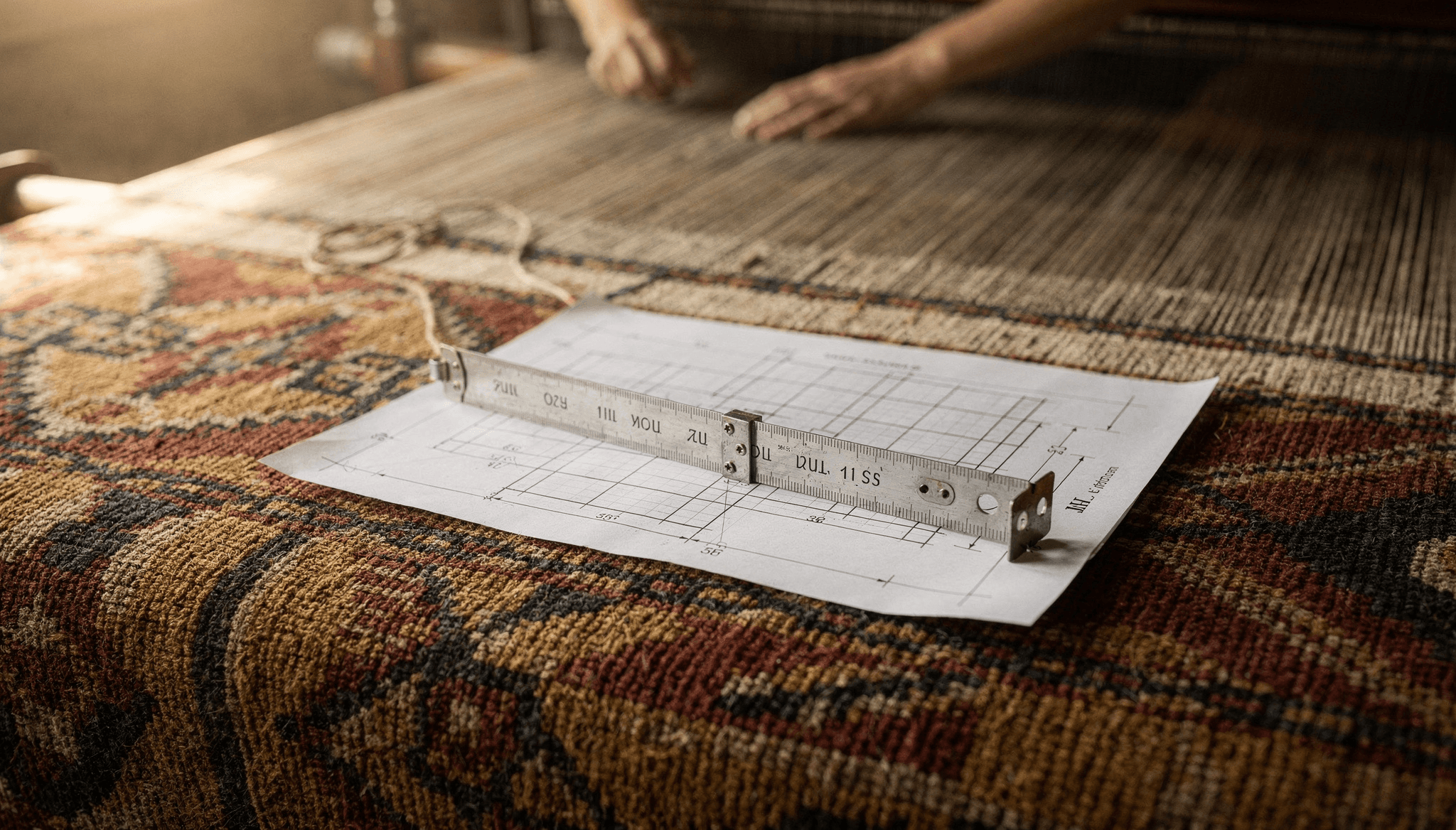
An off-the-shelf rug is a compromise: the room adapts to the format instead of the format to the room. Handknotting reverses that relationship. Every piece is made individually on the loom, so it can be made in any dimension. For planning purposes that means: you draw, we knot.
What is possible
Seamless fields up to around five meters wide at unrestricted length cover almost every residential and contract situation, from a narrow runner to an eight-meter band for a gallery to one continuous field under a seating landscape. Larger widths can be realized by project.
Proportion is equally free. A rug can follow a long dining table, run through a library as a narrow band, or hold a lobby as a generous island. Rules of thumb like "leave 30 centimeters of floor showing" are starting points, not laws; what matters is the zone the rug is meant to define in the room.
Shapes and cutouts
Round, oval, curved, asymmetric: any shape that can be handed over as a drawing can be knotted. Stair runners are made with continuous pattern flow; open floor plans get shapes that trace sightlines and furniture.
Cutouts for columns, fireplaces or built-ins are worked in from the floor plan or a template and finished cleanly at the cut edges, so the cutout reads as part of the piece rather than an afterthought. For complex geometry, a paper or foil template taken from the original beats any chain of measurements.
Tolerances, stated honestly
A hand-knotted piece is not an industrial product, and that shows in the dimension too. Expect a tolerance of around two percent, in practice usually well under it. On a three-meter edge that is a few centimeters.
For a free-lying rug this is irrelevant. It matters where the piece must sit flush: in a recessed floor, between two built-ins, exactly on an alignment line. Tell us about such situations before production starts; the piece is then worked toward the critical dimension and sheared and blocked to it at the end.
The process
From measurement to finished piece, four steps.
First the dimension: a floor plan, CAD drawing or a dimensioned sketch is enough. For special shapes, a template helps.
Then the technical drawing: you receive a production drawing from us with all dimensions, the shape and the position of the pattern in the format. Only your approval of this drawing starts production.
Then the knotting: the piece is made in the approved quality, color and pile height. On request we document progress with photos from the loom.
Finally finishing and inspection: after washing and shearing the piece is checked against the dimension, blocked and prepared for shipping. The timeline matches a regular production run; reference figures are in the contract and project guide.
What custom sizing costs
The billing is unspectacular: you pay for the actual area in the chosen quality. A rectangular rug at 287 by 412 centimeters carries no "custom surcharge"; it costs its square meters. Special shapes carry a moderate addition for construction, cutting and edging; cutouts likewise. What moves the price is knot density, not shape. To steer the budget, steer the quality, not the dimension.
For a concrete quote, a dimension or floor plan, a color direction and the intended location are enough. Send us your inquiry; you will receive an assessment of feasibility and budget within two working days.