Persian or Turkish Knot: Two Ways to Knot a Rug
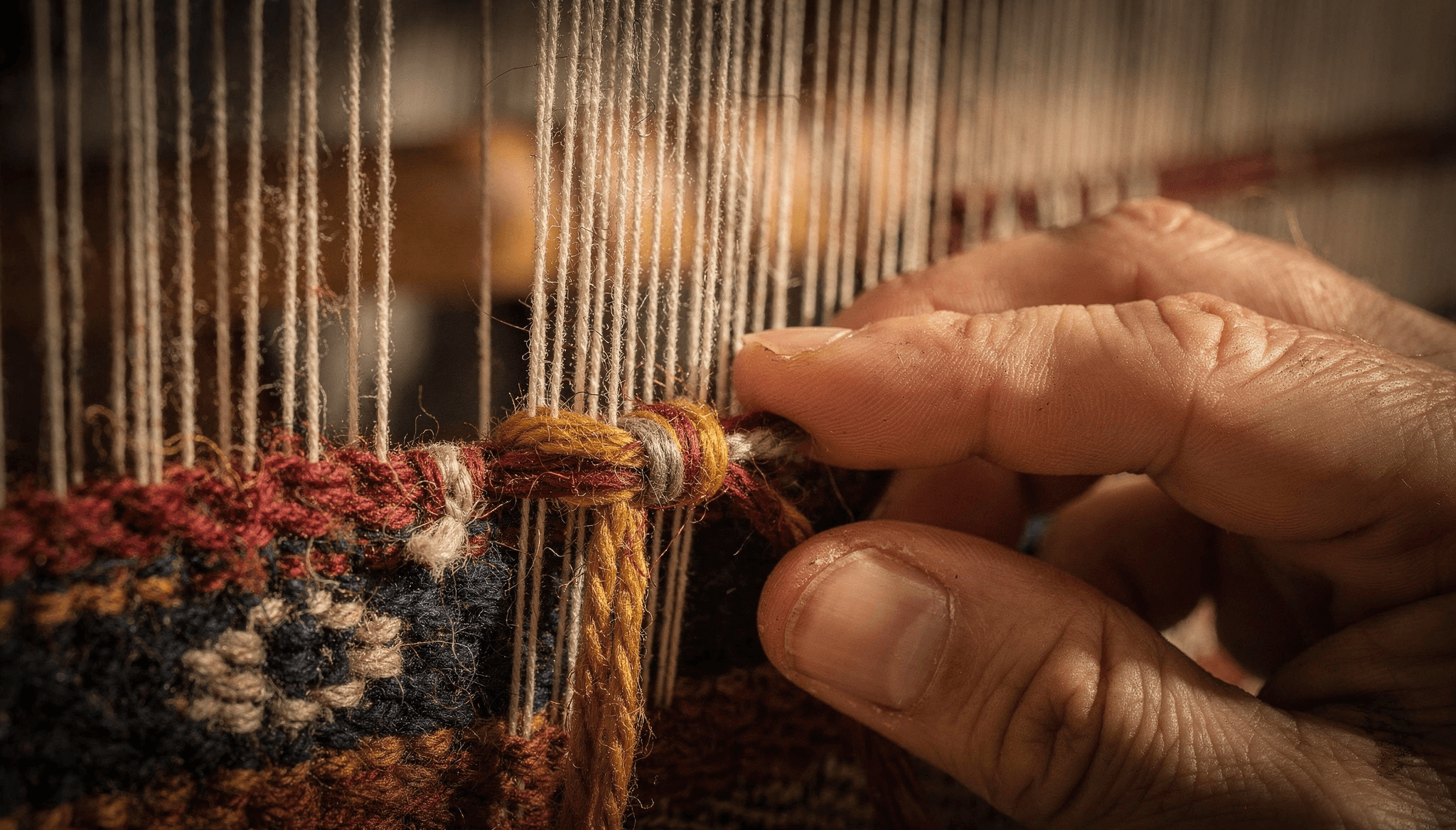
At the bottom of every handknotted rug, beneath pattern, color and pile, lies a decision between two hand movements. For centuries the craft has known, at its core, two ways of tying a knot around the warp threads, and which of the two carries a piece shapes its drawing, its possible fineness and its character. Understand the two movements and you hold a key to the whole craft.
The symmetric knot
In the symmetric knot, known in the trade as the Turkish or Ghiordes knot, the yarn is laid over two neighboring warp threads, carried around behind both, and both ends surface together between the warps. The result is a fully closed, firmly locked knot that grips the warp like a small clamp.
This construction has consequences. The symmetric knot sits extraordinarily firm and makes pieces robust and dimensionally stable; in return it builds slightly wider and sets earlier limits to the fineness of the drawing. Its home is the powerful, geometric traditions: Anatolia, the Caucasus, the nomadic rugs, and among the classical Persian provenances, of all places, some of the most famous; Tabriz, for one, whose weavers work the symmetric knot with the hook.
The asymmetric knot
The asymmetric knot, known in the trade as the Persian or Senneh knot, wraps only one of the two warp threads completely and merely passes beneath the second; depending on which side it opens to, it is called open left or open right. It is the slimmer, more supple construction: the knots move closer together, the rows close tighter, and the drawing gains resolution.
That makes the asymmetric knot the tool of the fine line. Curving vines, script, flowing contours, the highest knot densities: where the drawing turns curvilinear and detailed, its build pays off. Persia in large parts, China and, essentially, India knot asymmetrically; the manufactories Carpetstory works with use this knot too, for exactly this reason.
The irony of the names
Take the terms too literally and the craft will gently correct you. The town of Senneh, namesake of the "Persian" knot, knotted its famous rugs predominantly in the symmetric, that is "Turkish", knot, and Tabriz, one of the great Persian addresses, does so to this day. The names are nineteenth-century trade conventions, not maps. To be precise, say symmetric and asymmetric, and read a rug's origin from material, pattern and construction, not from the knot's name.
What the choice means for a piece
For practice, the consequences fit in three sentences. Achievable fineness: the highest densities and filigree drawing argue for the asymmetric knot; what density delivers and costs is explored in the essay on knot density. Character: powerful geometry and nomadic directness are the domain of the symmetric knot, flowing elegance that of the asymmetric. Durability: both knots carry for decades when density and material are right; no serious house sells one as "better" than the other, but chooses by design.
With a little practice, the two can be told apart on the back: the symmetric knot shows two even yarn dots side by side per knot, the asymmetric a finer, slightly offset picture. For everyday purposes, the more important question is whether a piece was hand-knotted at all; the check for that is in identifying a genuine handknotted rug.
Margin notes for the precise
Two relatives deserve a mention. The Tibetan technique, at home in Nepal and the Himalayas, loops the yarn continuously around a metal rod that is then cut open; a third path with a pile character of its own, which plays only at the margins here. And the jufti knot, tied over four warp threads instead of two, is not a third path but a shortcut: half the work, half the density, half the durability. Where it appears, someone is saving at the wrong end; how to spot it is in the knot density essay.
Small as the decision between two hand movements seems, repeated millions of times it becomes the character of a piece. How knots become rows and rows become rugs is shown in from design to loom; the full picture of the craft is drawn in handknotted rugs from India.