Rugs and Underfloor Heating: What Actually Matters
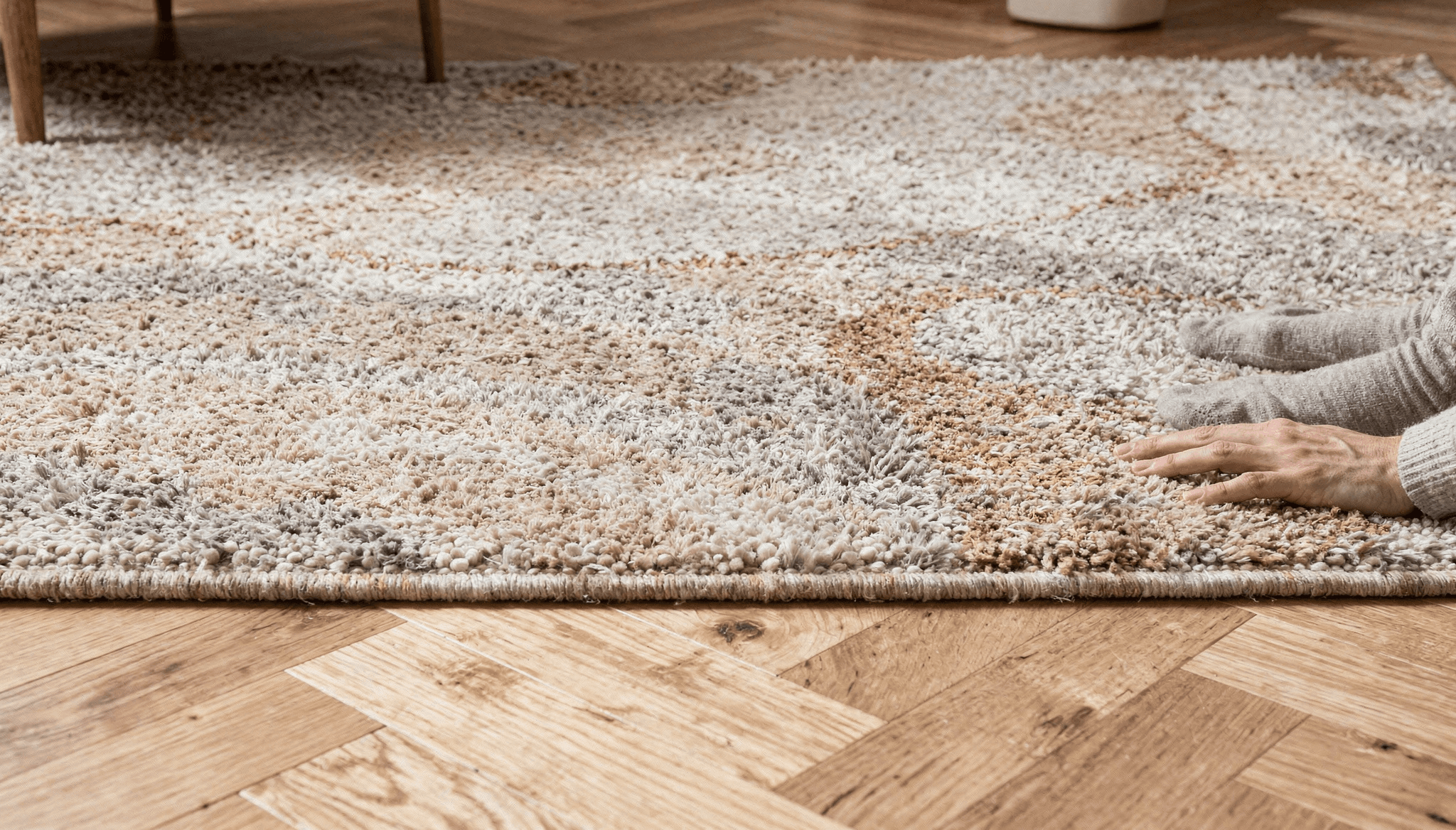
Few questions reach us from Germany as reliably as this one: do a handknotted rug and underfloor heating get along? The short answer is yes, without reservations. The longer answer is still worth having, because it explains which two quantities actually matter, and clears up, along the way, the worry that fine wool and warm floors are enemies.
What the heating does to the rug: nothing
First, the worry about the piece itself. Hydronic underfloor heating works with moderate surface temperatures; the relevant standards cap them in occupied zones below 30 degrees Celsius. For wool, that is a summer day. A fiber that passes through a multiple of that in the dye bath takes no harm whatsoever from a warm floor, and craft dyeing, plant or chrome, remains equally unimpressed. Wool also regulates moisture by nature and does not embrittle in the drier air of heated rooms; the material portrait describes these properties in detail. So that worry can be ticked off: the heating does not harm the rug.
What the rug does to the heating: it dampens it locally
The second quantity is the physically interesting one. Every floor covering opposes the heat flow with a resistance, the thermal resistance, and a rug raises it across its area. That does not mean the warmth disappears; it comes through damped and more slowly, and a normal system compensates without difficulty. Wool, for that matter, passes warmth on pleasantly: a wool rug on a heated floor does not feel cold but tempered, just gentler than the bare tile beside it.
How large the damping is, is determined by build-up height and density: pile height plus underlay. From this follow the two practical levers of the subject.
The two levers: pile and underlay
For the pile, short to medium is the uncomplicated choice, roughly six to twelve millimeters, ideally densely knotted; a dense, short pile passes warmth better than a high, loose one. That aligns nicely with what holds for used rooms anyway, as the guide on durability shows. Very high piles are not forbidden, but they insulate noticeably and do not belong on systems that are tightly dimensioned to begin with.
For the underlay: thin, and expressly rated for underfloor heating. Such an anti-slip underlay stays flat, lets warmth pass and protects rug and floor alike; its other virtues are described in the care guide. What to avoid: thick felt underlays that insulate unnecessarily, and cheap rubber grades without a suitability rating, which can leave marks on sensitive floors under warmth. The label "suitable for underfloor heating" is not a platitude here; it is the selection criterion.
The special case: tightly dimensioned low-temperature systems
An honest qualification for planning: in very efficient new buildings, where the heating runs at low flow temperatures and is dimensioned exactly to the heat demand, every square meter of covered heating surface counts. Whoever wants to lay rugs across large areas there best takes the subject into the heat-load planning, or discusses it with the planner before the piece is made rather than after. In projects we handle this coordination as part of the job; it has its fixed place in the contract and project guide, and with made-to-measure pieces the rug zone can be cut to the room and its heating surfaces from the start.
Electric surface heating is the second special case: these systems vary more, and for coverings the specifications of the respective manufacturer apply. A look into their documentation before laying spares discussion afterwards.
The conclusion in one sentence
Short to medium pile, a thin rated underlay, and on tightly dimensioned systems a word with the planner: that is all it takes for handknotted wool and underfloor heating to be lasting good neighbors. For questions about your specific room, a floor plan and the heating system are enough; you will receive a recommendation on quality, pile and underlay within two working days.